Everything You Should Know About Eyelid Surgery (Blepharoplasty)
Do People Often Ask If They Look Tired Even When They Feel Fine?
Many people notice that as they get older, their eyes no longer reflect how energetic they feel.
Friends may ask, “Are you tired?” even after a good night’s sleep. Some people struggle with heavy upper eyelids that make them look older, while others develop puffiness or bags beneath the eyes that never seem to improve with skincare products.
In some cases, loose upper eyelid skin can even interfere with vision, making everyday activities like reading or driving more difficult.
When this happens, the problem is usually not a lack of sleep. It is often caused by excess skin, bulging fat, and age-related changes around the eyes.
This is where blepharoplasty, also called eyelid surgery, can help.
As a board-certified plastic surgeon in Gurgaon, Delhi NCR, Dr. Anmol Chugh believes that successful eyelid surgery should refresh the eyes while preserving natural facial expressions. The goal is to help patients look well-rested and natural, not different.
Table of Contents
- Quick Answer
- What Is Blepharoplasty?
- Why Do Eyelids Change With Age?
- Who Can Benefit From Eyelid Surgery?
- Who Should Avoid Eyelid Surgery?
- Types of Blepharoplasty
- What Are the Benefits of Blepharoplasty?
- Dr. Anmol’s Clinical Perspective: What I Commonly See in My Practice
- Common Mistakes Patients Make
- What Happens During Blepharoplasty?
- Recovery Timeline After Blepharoplasty
- Recovery Protocol Followed at Our Centre
- Safety Checklist Before Eyelid Surgery
- What Are the Risks of Blepharoplasty?
- What I Tell My Patients During Consultation
- Frequently Asked Questions
- Final Thoughts
Quick Answer
Blepharoplasty is a surgical procedure that removes or repositions excess skin and fat from the upper or lower eyelids. It can improve drooping eyelids, reduce under-eye bags, create a more refreshed appearance, and, in some patients, improve vision when excess upper eyelid skin blocks the visual field.
What Is Blepharoplasty?
Blepharoplasty, commonly known as eyelid surgery, is performed to improve the appearance and, in some cases, the function of the eyelids.
Depending on your concerns, surgery may involve:
- Removing excess upper eyelid skin
- Removing or repositioning fat around the eyes
- Tightening loose skin
- Improving the contour of the eyelids
- Correcting eyelids that interfere with vision
The procedure can be performed on:
- Upper eyelids
- Lower eyelids
- Both upper and lower eyelids together
The treatment plan depends on each patient’s anatomy, skin quality, and goals.
Why Do Eyelids Change With Age?
The skin around the eyes is the thinnest skin on the body.
As we age, several natural changes occur:
- Skin gradually loses collagen and elasticity.
- Supporting muscles become weaker.
- Fat around the eyes begins to bulge forward.
- Eyebrows may descend slightly.
- Gravity causes skin to stretch over time.
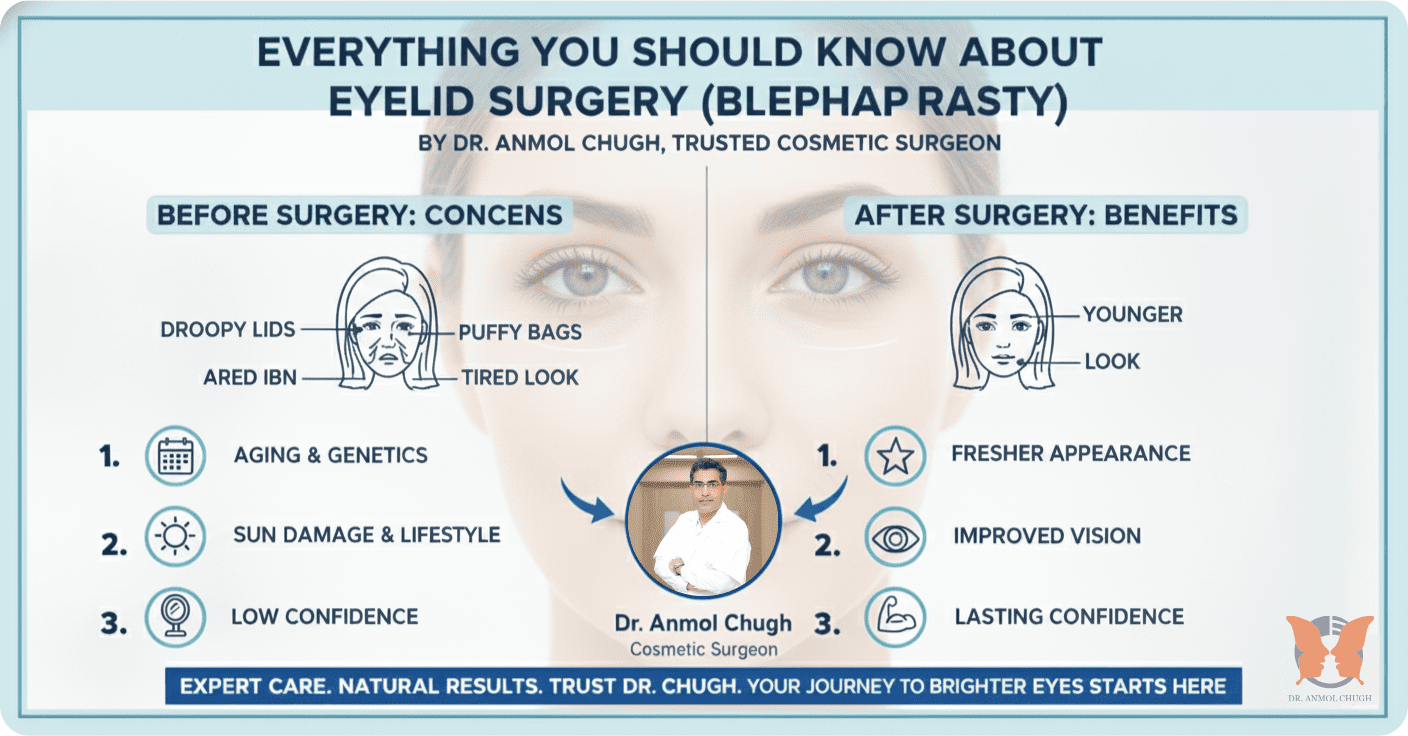
These changes may result in:
- Heavy upper eyelids
- Hooded eyes
- Puffy under-eye bags
- Loose eyelid skin
- Wrinkles around the eyes
- A tired or older appearance
Although ageing is the most common cause, genetics also plays an important role. Some younger adults naturally develop prominent under-eye bags because of inherited fat distribution.
Who Can Benefit From Eyelid Surgery?
You may be a suitable candidate for blepharoplasty if you:
- Have drooping upper eyelids
- Notice persistent bags beneath the eyes
- Feel your eyes make you look tired or older than you feel
- Have loose upper eyelid skin affecting your vision
- Are in good general health
- Have realistic expectations about the results
Many patients choose surgery between the ages of 40 and 70, although younger patients with inherited eyelid puffiness may also benefit.
Also Read: The Top 5 Reasons to Consider Blepharoplasty for a Youthful Look
Who Should Avoid Eyelid Surgery?
Blepharoplasty may need to be postponed or may not be suitable if you have:
- Uncontrolled diabetes
- Severe dry eye syndrome
- Active eye infection
- Uncontrolled glaucoma
- Poorly controlled thyroid eye disease
- Serious medical conditions that increase surgical risk
- Unrealistic expectations
A detailed consultation and examination help determine whether surgery is appropriate for you.
Types of Blepharoplasty
Upper Eyelid Surgery
Upper blepharoplasty removes excess skin and, when necessary, small amounts of fat from the upper eyelids.
This procedure is commonly recommended for patients who have:
- Heavy eyelids
- Hooded eyes
- Skin hanging over the eyelashes
- Vision obstruction caused by excess skin
The incision is carefully placed within the natural eyelid crease so that it becomes difficult to notice after healing.
Lower Eyelid Surgery
Lower blepharoplasty focuses on the area beneath the eyes.
It helps improve:
- Puffy eye bags
- Loose lower eyelid skin
- Under-eye fullness
- Tired appearance
Instead of simply removing fat, modern techniques often reposition fat to create a smoother transition between the eyelid and the cheek. This usually produces more natural, long-lasting results.
Combined Upper and Lower Eyelid Surgery
Many patients choose to treat both upper and lower eyelids during the same operation.
This provides more balanced facial rejuvenation while requiring only one recovery period.
The exact surgical plan depends on the patient’s individual needs rather than following a standard approach.
What Are the Benefits of Blepharoplasty?
When performed appropriately, eyelid surgery can provide both cosmetic and functional improvements.
Common benefits include:
- A fresher, more rested appearance
- Better definition of the upper eyelid
- Reduction of under-eye bags
- Improved upper visual field in selected patients
- Better facial balance
- Increased self-confidence
Research has also shown that patients often report improvements in quality of life after blepharoplasty, particularly when vision has been affected by drooping eyelids.
Dr. Anmol’s Clinical Perspective: What I Commonly See in My Practice
Many patients tell me they have tried almost everything before considering surgery.
They use expensive eye creams, home remedies, cosmetic treatments, or makeup techniques to hide heavy eyelids or under-eye bags.
While these treatments may temporarily improve skin quality, they cannot remove excess skin or reposition bulging fat.
One important point I discuss during consultation is that blepharoplasty should never make someone look like a different person.
The goal is subtle improvement.
When eyelid surgery is carefully planned, friends and family often notice that the patient looks refreshed and well-rested without immediately realising that surgery has been performed.
That is usually the best compliment a patient can receive.
Common Mistakes Patients Make
Waiting Until Vision Becomes Significantly Affected
Many people assume heavy eyelids are simply part of ageing and postpone treatment for years.
If excess skin begins interfering with daily activities or vision, an early evaluation is worthwhile.
Expecting Eye Creams to Remove Excess Skin
Good skincare supports healthy skin but cannot remove loose eyelid skin or prominent fat bags.
Once significant structural changes develop, surgery is usually the most effective option.
Choosing Surgery Based Only on Price
The eyelids are delicate structures that require careful planning and precision.
Choosing an experienced plastic surgeon based on training, expertise, and safety is far more important than selecting the lowest cost.
Expecting Perfection
No surgical procedure can stop the natural ageing process.
The goal of blepharoplasty is to create natural, refreshed eyes that continue to age gracefully, not permanently freeze time.
Also Read: Is Blepharoplasty Right for You? Key Factors to Consider
What Happens During Blepharoplasty?
Blepharoplasty is usually performed as a day-care procedure, meaning most patients go home on the same day.
Depending on the treatment plan, the surgery may be performed under local anaesthesia with sedation or general anaesthesia.
The procedure generally involves:
- Careful marking of the eyelids before surgery
- Small incisions placed within the natural eyelid crease or just below the eyelashes
- Removal or repositioning of excess fat
- Removal of loose skin when required
- Fine sutures to close the incisions
Most eyelid surgery procedures take approximately 1–2 hours, depending on whether the upper eyelids, lower eyelids, or both are being treated.
The aim is to preserve the natural shape of the eyes while creating a refreshed appearance.
Recovery Timeline After Blepharoplasty
Healing is gradual, and every patient recovers at a slightly different pace.
First 48 Hours
- Mild swelling and bruising are expected.
- Cold compresses help reduce swelling.
- The eyes may feel tight or watery.
First Week
- Swelling begins to improve.
- Most patients feel comfortable doing light daily activities.
- Sutures are usually removed if non-absorbable stitches are used.
Second Week
- Bruising continues to fade.
- Many patients return to work and social activities.
- Most swelling becomes much less noticeable.
Four to Six Weeks
- The eyelids continue to soften.
- Scars become less visible.
- Patients can usually resume all normal activities after their surgeon’s approval.
Final refinement of the scars and eyelid contour may continue for several months.
Recovery Protocol Followed at Our Centre
Recovery is just as important as the surgery itself.
At our centre, patients receive detailed aftercare instructions that typically include:
- Applying cold compresses during the first few days
- Using prescribed eye drops or ointments
- Keeping the head elevated while sleeping
- Avoiding rubbing the eyes
- Wearing sunglasses outdoors
- Avoiding contact lenses until advised
- Gradually returning to exercise
- Attending scheduled follow-up appointments
Following these instructions helps reduce swelling, supports healing, and improves the final result.
Safety Checklist Before Eyelid Surgery
Before undergoing blepharoplasty, patients should:
✔ Have a complete medical evaluation
✔ Inform the surgeon about all medications and supplements
✔ Stop smoking for at least 4 weeks before and after surgery
✔ Arrange transportation home after surgery
✔ Avoid blood-thinning medications if advised by the treating doctor
✔ Discuss any history of dry eyes, glaucoma, thyroid eye disease, or previous eye surgery
Proper planning helps improve both safety and recovery.
Real Blepharoplasty Patient Result

See More Real Blepharoplasty Patient Results in Our Before & After Gallery.
What Are the Risks of Blepharoplasty?
Like every surgical procedure, blepharoplasty has potential risks.
These may include:
- Swelling
- Bruising
- Dry eyes
- Temporary blurred vision
- Infection
- Bleeding
- Visible scarring (uncommon)
- Eyelid asymmetry
- Difficulty fully closing the eyes (usually temporary)
- Need for revision surgery (rare)
Most complications are uncommon and can often be minimised through careful patient selection, meticulous surgical technique, and proper aftercare.
Discussing these risks honestly helps patients make informed decisions.
What I Tell My Patients During Consultation
One question patients frequently ask is:
“Will people know I’ve had eyelid surgery?”
My answer is simple.
Good blepharoplasty should not make you look like someone else.
It should simply make you look less tired.
The goal is not to remove every wrinkle or dramatically change the eyes.
Instead, we aim to restore natural eyelid contours while preserving your facial expressions and individuality.
I also remind patients that surgery improves excess skin and fat, but healthy lifestyle habits, sun protection, and good skincare continue to play an important role in maintaining long-term results.
Frequently Asked Questions
1. Is blepharoplasty painful?
Most patients describe mild discomfort rather than significant pain. Any discomfort is usually well controlled with prescribed medications.
2. Will there be visible scars?
Incisions are carefully hidden within the natural eyelid crease or just beneath the eyelashes. As healing progresses, scars usually become very difficult to notice.
3. How long do the results last?
Results are generally long-lasting. Although the natural ageing process continues, many patients enjoy the benefits of blepharoplasty for 10 years or longer.
4. Can eyelid surgery improve vision?
Yes. When excess upper eyelid skin blocks the upper visual field, upper blepharoplasty can improve vision as well as appearance.
5. When can I return to work?
Many patients return to office work within 7–10 days, depending on the amount of swelling and the nature of their job.
6. Can I wear contact lenses after surgery?
Most patients are advised to avoid contact lenses for about 2 weeks or until their surgeon confirms it is safe.
7. Can blepharoplasty be combined with other procedures?
Yes. Depending on your goals, eyelid surgery may sometimes be combined with procedures such as a brow lift, facelift, or facial fat grafting after appropriate evaluation.
8. Will eye creams give the same result as surgery?
No. Eye creams may improve skin hydration and texture, but they cannot remove excess skin or reposition fat. When significant eyelid ageing is present, surgery remains the most effective treatment.
Final Thoughts
Ageing around the eyes is one of the earliest facial changes many people notice. Drooping upper eyelids, under-eye bags, and loose skin can make you look tired even when you feel energetic.
Blepharoplasty is designed to address these concerns by removing or repositioning excess skin and fat while preserving the natural appearance of the eyes. For suitable candidates, the procedure can improve both appearance and, in some cases, vision affected by heavy upper eyelids.
The best outcomes come from careful assessment, realistic expectations, meticulous surgical technique, and proper recovery.
If you are considering eyelid surgery and would like to understand whether it is the right option for you, a consultation with an experienced plastic surgeon in Gurgaon, Delhi NCR, can help you explore your options and make an informed decision.
Related Procedures
References
- American Society of Plastic Surgeons. Eyelid Surgery (Blepharoplasty).
https://www.plasticsurgery.org/cosmetic-procedures/eyelid-surgery - American Academy of Ophthalmology. Blepharoplasty (Eyelid Surgery).
https://www.aao.org/eye-health/treatments/what-is-blepharoplasty - Codner MA, McCord CD Jr, Hester TR Jr. Upper and Lower Blepharoplasty: Current Concepts. Plastic and Reconstructive Surgery. 2010.
https://doi.org/10.1097/PRS.0b013e3181ea4473 - Rohrich RJ, Ghavami A, Mojallal A. Current Concepts in Lower Blepharoplasty. Aesthetic Surgery Journal. 2007;27(6):623–635.
https://doi.org/10.1016/j.asj.2007.08.006 - American Board of Cosmetic Surgery. Eyelid Surgery (Blepharoplasty) Guide.
https://www.americanboardcosmeticsurgery.org/procedure-learning-center/face/eyelid-surgery/ - National Institute for Health and Care Excellence (NICE). Cosmetic Procedures: Blepharoplasty – Evidence and Guidance.
https://www.nice.org.uk
Medically Reviewed By
Dr. Anmol ChughQualifications: MBBS, MS, MCh (Plastic Surgery)
Experience: 16+ Years in Plastic & Aesthetic Surgery
Review Date: 11 Dec 2025
This article has been medically reviewed for accuracy and patient safety.