Non-Surgical Aesthetics: Why “No Surgery” Does Not Mean “No Science”
Many people hear the words non-surgical treatment and assume the procedure must be simple, risk-free, or similar to a beauty salon treatment.
This is one of the biggest misconceptions in aesthetic medicine.
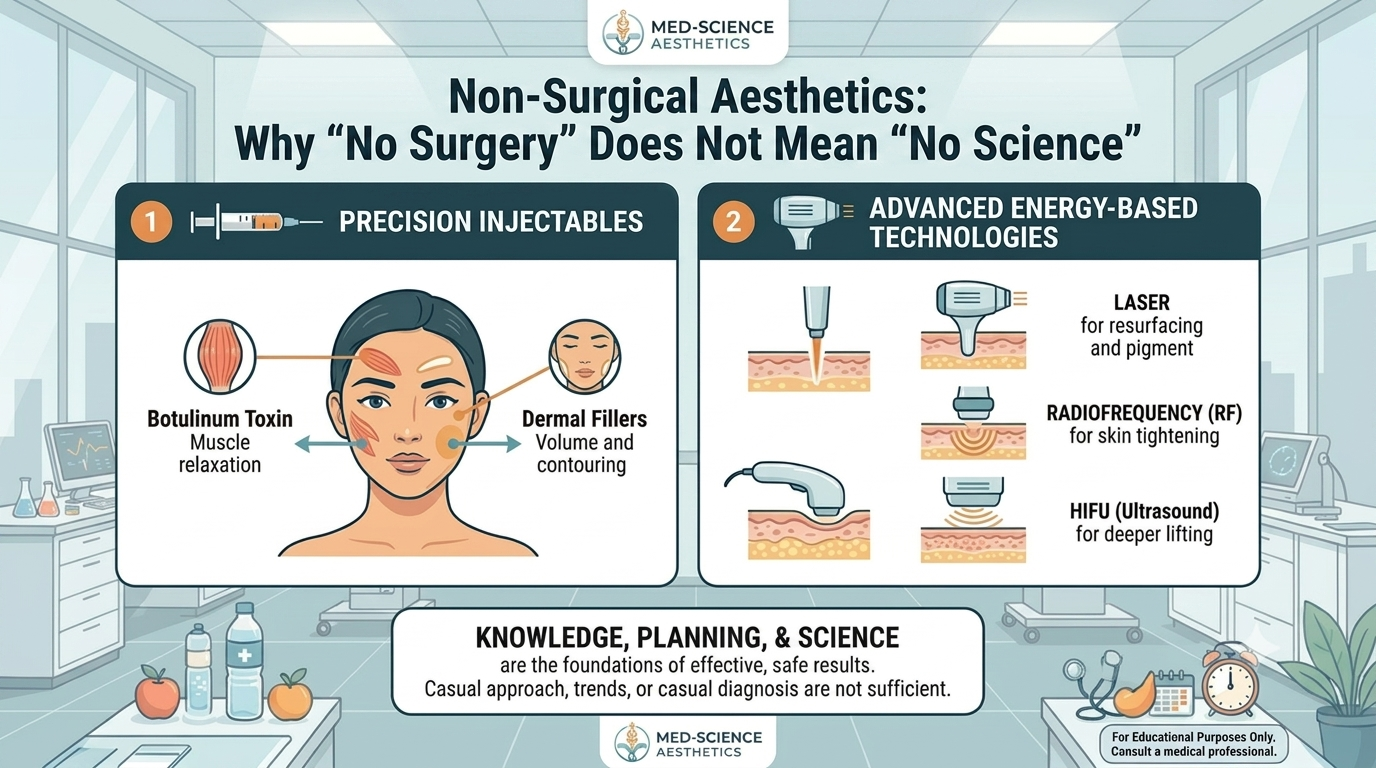
Whether it is Botox, dermal fillers, skin boosters, laser treatments, radiofrequency tightening, or High-Intensity Focused Ultrasound (HIFU), these procedures involve detailed knowledge of facial anatomy, aging patterns, product science, and patient safety.
The fact that a treatment does not require surgery does not mean it can be performed casually.
In reality, some of the most challenging decisions in aesthetic medicine involve non-surgical treatments because subtle changes can significantly affect facial appearance. Good outcomes depend not only on the product being used but also on proper patient selection, treatment planning, and an understanding of facial anatomy.
One of the most important things patients should understand is that successful aesthetic treatments are based on science, not trends.
Table of Contents
- What Are Non-Surgical Aesthetic Treatments?
- Why Non-Surgical Treatments Are Based on Science
- Understanding Botox: More Than Just Wrinkle Treatment
- Understanding Dermal Fillers
- Who Is a Good Candidate for Non-Surgical Aesthetics?
- Who Should Avoid Non-Surgical Treatments?
- Dr. Anmol Chugh’s Clinical Perspective
- Common Mistakes Patients Make
- What I Commonly See in My Practice
- Risks and Possible Complications
- Recovery After Non-Surgical Treatments
- Important Facts Patients Should Know
- Non-Surgical Aesthetics in Gurgaon and Delhi NCR
- Frequently Asked Questions
What Are Non-Surgical Aesthetic Treatments?
Non-surgical aesthetics refers to cosmetic procedures that improve appearance without traditional surgery.
Common examples include:
- Botulinum toxin (Botox) injections
- Dermal fillers
- Skin boosters
- PRP (Platelet-Rich Plasma)
- Laser skin treatments
- Radiofrequency skin tightening
- HIFU treatments
- Chemical peels
- Microneedling
These procedures can address concerns such as:
- Fine lines and wrinkles
- Volume loss
- Skin laxity
- Uneven skin texture
- Pigmentation
- Acne scars
- Early signs of aging
While they are less invasive than surgery, they still require medical knowledge and careful planning.
Why Non-Surgical Treatments Are Based on Science
Aging is not caused by a single factor.
Scientific studies show that facial aging involves changes in:
- Skin quality
- Collagen production
- Fat distribution
- Bone structure
- Muscle activity
- Environmental damage from sunlight and pollution
A comprehensive review published in 2025 highlighted that facial aging is a multifactorial process influenced by genetics, hormonal changes, ultraviolet exposure, pollution, lifestyle habits, and collagen loss.
This is why different patients require different treatments.
A patient with volume loss may benefit from fillers.
A patient with dynamic wrinkles may benefit from botulinum toxin.
Someone with skin laxity may require energy-based treatments or surgery rather than injections.
The treatment should address the underlying cause, not just the visible symptom.
Understanding Botox: More Than Just Wrinkle Treatment
Botulinum toxin is one of the most commonly performed non-surgical procedures worldwide.
Many people think Botox simply “freezes” the face.
In reality, it works by temporarily reducing the activity of specific facial muscles that contribute to wrinkle formation.
It is commonly used for:
- Forehead lines
- Frown lines
- Crow’s feet
- Jawline slimming
- Gummy smile correction
Research has shown that botulinum toxin can improve dynamic wrinkles and facial expression lines when used appropriately.
The goal is not to eliminate all movement but to soften excessive muscle activity while preserving natural facial expressions.
Understanding Dermal Fillers
Another common misconception is that fillers are used simply to make lips bigger.
Modern filler treatments focus on restoring facial balance and volume.
As we age, natural hyaluronic acid levels decrease, leading to volume loss and reduced skin hydration. Hyaluronic acid fillers are designed to restore some of this lost support and improve facial contours.
Fillers may be used to improve:
- Cheek volume
- Under-eye hollows
- Jawline definition
- Chin projection
- Nasolabial folds
- Lip shape and balance
The objective is not to make the face look different but to restore proportions that have changed over time.
Who Is a Good Candidate for Non-Surgical Aesthetics?
You may be a suitable candidate if:
- You have early signs of facial aging.
- You want subtle improvements.
- You are not ready for surgery.
- You have realistic expectations.
- You are in good general health.
Many patients choose non-surgical treatments because they involve less downtime than surgery.
However, realistic expectations remain important.
These treatments can improve certain concerns but cannot replace surgical procedures when significant skin laxity or structural changes are present.
Who Should Avoid Non-Surgical Treatments?
Non-surgical procedures may not be appropriate for:
- Pregnant or breastfeeding women.
- Patients with active skin infections.
- Individuals with certain neurological disorders.
- Patients with unrealistic expectations.
- People seeking dramatic surgical-level results from injections alone.
A consultation helps determine whether non-surgical treatment, surgery, or a combination approach is most appropriate.
Dr. Anmol Chugh’s Clinical Perspective
One of the most important points I discuss with patients is that non-surgical treatment does not mean simple treatment.
Every injection, laser session, or skin-tightening procedure affects living tissues and should be approached with the same respect given to other medical treatments.
The goal should never be to chase trends or imitate social media filters.
Instead, treatment should focus on:
- Understanding facial anatomy
- Maintaining natural facial expressions
- Preserving facial balance
- Addressing the actual cause of aging
- Creating subtle and harmonious improvements
The best results are usually the ones that look natural and allow people to look refreshed rather than obviously treated.
Common Mistakes Patients Make
Some of the most common mistakes I see include:
Following Social Media Trends
Many patients request treatments because they are popular online rather than because they are appropriate for their specific concerns.
Expecting One Treatment to Solve Everything
Different aging concerns require different treatment approaches.
A filler cannot replace a facelift, and Botox cannot correct volume loss.
Choosing Treatment Without Proper Assessment
Treating visible symptoms without understanding the underlying cause often leads to disappointing outcomes.
Assuming Non-Surgical Means Risk-Free
Even minimally invasive treatments carry risks and require proper planning and expertise.
What I Commonly See in My Practice
In my practice, many patients request a specific treatment because they have seen it on social media.
A patient may ask for fillers when the real issue is skin laxity. Another may request Botox when volume loss is actually the primary concern.
The most important part of any consultation is identifying the reason a concern exists rather than simply treating the visible symptom.
I also see patients who believe that non-surgical treatments are completely risk-free because there are no incisions involved. While these procedures are generally safe when performed appropriately, they are still medical treatments that require proper assessment and technique.
The best results usually come from a personalized treatment plan rather than following trends.
Risks and Possible Complications
Every medical procedure carries potential risks.
Botulinum Toxin Risks
Possible side effects include:
- Bruising
- Swelling
- Headache
- Temporary asymmetry
- Eyelid drooping (ptosis)
The medical literature also highlights rare complications such as muscle weakness, difficulty swallowing, and other adverse effects when treatments are not performed appropriately.
Dermal Filler Risks
Possible complications include:
- Swelling
- Bruising
- Lumps or nodules
- Infection
- Asymmetry
Although uncommon, vascular occlusion is a serious complication that requires immediate recognition and treatment.
This is one reason why facial anatomy knowledge is critical.
Energy-Based Device Risks
Potential complications may include:
- Temporary redness
- Swelling
- Pigment changes
- Skin irritation
- Rare burns or scarring
Proper patient selection and appropriate treatment settings help minimize these risks.
Recovery After Non-Surgical Treatments
Recovery varies depending on the procedure.
Botox
- Usually minimal downtime.
- Most patients resume normal activities immediately.
Fillers
- Mild swelling and bruising may occur.
- Most patients return to routine activities within one to two days.
Lasers and Energy-Based Treatments
- Recovery varies from minimal redness to several days of downtime depending on treatment intensity.
PRP and Microneedling
- Mild redness typically resolves within a few days.
Most non-surgical procedures allow patients to return to work much sooner than surgery.
Important Facts Patients Should Know
- Non-surgical treatments are not risk-free.
- Results depend heavily on accurate diagnosis and proper treatment planning.
- Botox results typically last for 3–4 months.
- Facial aging involves changes in the skin, fat, muscles, and underlying bone structure.
- Fillers and injectables should be tailored to each individual’s facial anatomy.
- Some aesthetic concerns can only be effectively addressed through surgery.
Non-Surgical Aesthetics in Gurgaon and Delhi NCR
Patients in Gurgaon, Delhi NCR, and surrounding areas are increasingly interested in non-surgical treatments because they offer subtle improvements with relatively little downtime.
However, choosing treatment based solely on trends or social media recommendations can lead to disappointment.
A thorough facial assessment helps determine whether Botox, fillers, skin tightening procedures, laser treatments, or surgery would provide the most appropriate outcome.
Choosing a practitioner who understands facial anatomy, aging science, and complication management is important for achieving safe and natural-looking results.
Frequently Asked Questions
Are non-surgical treatments completely safe?
They are generally safe when performed appropriately, but every treatment carries potential risks and complications.
Is Botox the same as a filler?
No. Botox relaxes specific muscles, while fillers restore volume and contour.
Will I look unnatural after treatment?
The goal of modern aesthetic medicine is natural-looking improvement rather than dramatic change.
How long do Botox results last?
Most patients notice results lasting approximately 3 to 4 months.
Are fillers permanent?
Most commonly used fillers are temporary and gradually break down over time.
Can fillers migrate?
Improper placement or excessive treatment may contribute to migration in some cases.
Is there downtime?
Most non-surgical treatments involve little downtime compared with surgery.
Can these treatments replace a facelift?
No. Significant skin laxity often requires surgical correction.
At what age should I start non-surgical treatments?
There is no ideal age. Treatment depends on individual concerns rather than age alone.
Can men benefit from non-surgical treatments?
Yes. Many men seek treatment for wrinkles, volume loss, jawline definition, and skin quality improvement.
Conclusion
Non-surgical aesthetic treatments have transformed modern cosmetic medicine by providing effective options with minimal downtime. However, “non-surgical” should never be confused with “simple” or “risk-free.”
Successful outcomes depend on scientific understanding, proper diagnosis, careful planning, and individualized treatment selection.
Whether the concern is wrinkles, volume loss, skin laxity, pigmentation, or overall facial aging, the best treatment approach begins with understanding the underlying cause rather than simply treating visible symptoms.
If you are unsure which treatment may be appropriate for your concerns, a detailed consultation can help create a personalized plan focused on safe, natural, and long-lasting results.
References
- Rashid Y, Estela-Fernandez C, Sardar A, et al. Advances in Anti-aging Procedures: A Comprehensive Review of Surgical and Non-surgical Rejuvenation Techniques. Cureus. 2025.
- American Society of Plastic Surgeons (ASPS). Non-Surgical Facial Rejuvenation Resources.
- U.S. Food and Drug Administration (FDA). Dermal Fillers and Injectable Products Safety Information.
- Carruthers J, Carruthers A. Botulinum Toxin in Facial Rejuvenation.
- Alam M, Gladstone H, Kramer EM. ASDS Guidelines of Care for Injectable Fillers.
Related Procedures
Medically Reviewed By
Dr. Anmol ChughQualifications: MBBS, MS, MCh (Plastic Surgery)
Experience: 16+ Years in Plastic & Aesthetic Surgery
Review Date: 22 Jun 2026
This article has been medically reviewed for accuracy and patient safety.