
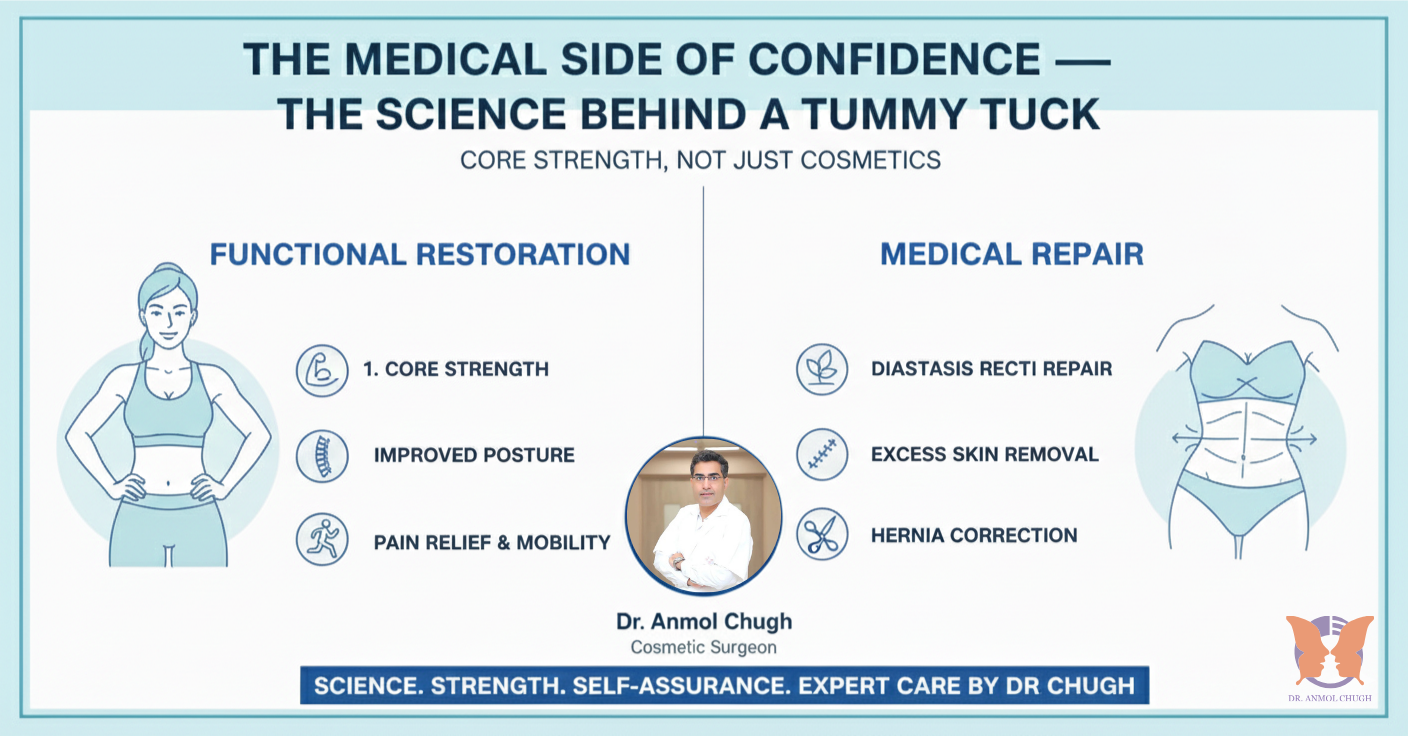
The Medical Side of Confidence: The Science Behind a Tummy Tuck
Confidence doesn’t always come from makeup or clothes, sometimes, it begins with comfort in your own body.
For many people, especially mothers or those who have lost a lot of weight, the abdominal area becomes a reminder of the body’s journey, stretched skin, weak muscles, and a core that feels less firm than before.
That’s where the tummy tuck, medically known as abdominoplasty, steps in.
As Dr. Anmol Chugh, a renowned plastic and reconstructive surgeon at CK Birla Hospital, Gurugram, explains:
“A tummy tuck is not just a cosmetic contouring procedure, it’s a medical repair that restores the foundation of your body: the core.”
In this blog, we’ll explore the science behind abdominoplasty, how it improves core strength, posture, and overall health, and why the result is not vanity, but confidence born from comfort.
Understanding the Core: More Than Just Muscles
Your core isn’t just about visible abs, it’s the powerhouse of your body.
It includes:
- Rectus abdominis (the “six-pack” muscles)
- Oblique muscles (on the sides of the abdomen)
- Transversus abdominis (the deep stabilizing muscle layer)
- Pelvic floor and back muscles
These muscles work together to:
- Support posture
- Protect internal organs
- Enable movement and balance
- Reduce strain on the spine
When this structure weakens, due to pregnancy, weight gain, or aging, it affects not just how you look, but how you feel and function.
What Happens to the Core After Pregnancy or Weight Changes
During pregnancy, the growing uterus stretches the abdominal wall, causing the rectus muscles to separate, a condition known as diastasis recti.
Even after childbirth, these muscles may not return to their original position. Similarly, after major weight loss, the abdominal skin and tissues may lose elasticity and hang loosely.
These changes often lead to:
Bulging or sagging abdomen
Poor posture
Back and hip pain
Core weakness
Difficulty exercising or standing upright
It’s not about looks, it’s about muscle dysfunction and loss of internal support.
As Dr. Chugh explains,
“When core muscles separate, your spine bears more load. Over time, this leads to back pain, posture issues, and even fatigue.”
This is where abdominoplasty becomes more than a cosmetic procedure, it’s medical reconstruction.
What a Tummy Tuck Actually Does, The Science Simplified
A tummy tuck (or abdominoplasty) is a surgical procedure that:
- Repairs weakened or separated abdominal muscles
- Removes excess skin and fat
- Tightens the abdominal wall
- Improves core strength and posture
Step-by-step overview:
- An incision is made in the lower abdomen (below the bikini line).
- The surgeon carefully tightens and sutures the separated muscles.
- Excess skin and fat are removed.
- The skin is smoothed and repositioned, leaving a firmer, flatter contour.
This combination of muscle repair and tissue tightening restores both structure and function.
As Dr. Anmol Chugh puts it:
“We’re not just reshaping the body, we’re rebuilding the muscle foundation that supports movement, balance, and health.”
The Medical Benefits of a Tummy Tuck
While many people associate a tummy tuck with aesthetics, its medical benefits are significant and scientifically proven.
✅ 1. Core Strength Restoration
The surgery brings the rectus muscles back together, strengthening the abdominal wall and restoring stability to the core.
This helps in daily activities like standing, bending, and lifting, without pain or fatigue.
✅ 2. Improved Posture
When the abdominal wall is weak, the spine compensates, often causing a “swayback” posture.
Tightened abdominal muscles support proper spinal alignment, resulting in better posture and less back strain.
✅ 3. Reduced Back Pain
Studies show that patients who undergo abdominoplasty experience less lower back pain because the surgery rebalances pressure on the spine.
Dr. Chugh explains,
“Once the core regains strength, the back muscles don’t have to overwork. That’s why many patients notice relief from chronic pain.”
✅ 4. Better Breathing and Mobility
A tightened core allows the diaphragm to move efficiently, improving breathing mechanics.
Patients often find it easier to exercise, move, and even sleep comfortably after recovery.
✅ 5. Correction of Hernias or Muscle Separation
Abdominoplasty can also help repair small umbilical or ventral hernias that develop when abdominal muscles weaken.
This adds an important medical advantage to the procedure beyond aesthetics.
✅ 6. Improved Bladder Control
Many women notice reduced urinary leakage (stress incontinence) after tummy tuck surgery because a stronger core supports pelvic floor stability.
✅ 7. Skin Health and Hygiene
Removing excess skin reduces skin irritation, rashes, and infections that occur in skin folds, improving comfort and hygiene.
Beyond the Scalpel: The Psychology of Core Confidence
When your posture improves, your confidence naturally follows.
It’s not just about a flatter stomach, it’s about standing taller, breathing deeper, and moving freely without pain or self-consciousness.
As Dr. Chugh says:
“Physical comfort creates emotional confidence. When women walk without pain, they rediscover their natural poise and inner strength.”
Many of his patients describe feeling:
- More energetic
- More engaged in fitness
- More comfortable in their clothes
- More connected with their bodies again
The transformation is often less about appearance and more about freedom and strength.
Tummy Tuck vs. Liposuction: The Key Difference
A common misconception is that liposuction and a tummy tuck are the same.
In reality, they serve different purposes.
| Aspect | Tummy Tuck (Abdominoplasty) | Liposuction |
| Focus | Muscle repair + skin removal | Fat removal only |
| Suitable For | Loose skin, stretched muscles | Localized fat bulges |
| Benefits | Core strength, posture, firmness | Smoother body contour |
| Result | Functional + aesthetic | Aesthetic only |
Both can be combined if needed, but the tummy tuck remains the choice for medical muscle repair and core rejuvenation.
The Healing Journey, What to Expect After Surgery
Healing from abdominoplasty is a process of strength rediscovery.
In the first few weeks:
- Mild tightness or soreness is normal.
- Walking and light movement are encouraged to improve circulation.
- Support garments help maintain shape and reduce swelling.
Within a few months:
- The abdomen feels firmer and lighter.
- Core strength improves noticeably.
- Posture straightens naturally.
Most patients resume regular activities within 3–4 weeks and enjoy full recovery within 2–3 months.
Dr. Chugh provides detailed post-operative guidance, focusing on:
- Gentle exercise routines
- Nutrition for healing
- Gradual strengthening plans
This holistic care ensures recovery that’s safe, comfortable, and sustainable.
The Science of Confidence, Mind Meets Body
The phrase “mind-body connection” isn’t just philosophy, it’s neuroscience.
When physical discomfort decreases, the brain releases dopamine and serotonin, improving mood and emotional balance.
When posture improves, confidence hormones like testosterone rise, making you feel more self-assured.
This is why so many patients say they feel “emotionally lighter” after a tummy tuck.
As Dr. Anmol Chugh explains,
“Restoring strength at the core isn’t just about muscles, it restores your sense of stability, energy, and confidence in life.”
The science is simple:
A stronger core = better posture = less pain = more confidence.
Common Myths About Tummy Tuck, Debunked
| Myth | Truth |
| “It’s only for vanity.” | It’s a medical reconstruction that restores muscle strength and posture. |
| “It’s the same as liposuction.” | Liposuction removes fat; abdominoplasty repairs muscles and skin. |
| “It’s unsafe or very painful.” | With modern surgical care by Dr. Chugh, it’s safe, with smooth recovery and manageable discomfort. |
| “Results don’t last.” | With good fitness and nutrition, results are long-lasting and functional. |
Who Can Benefit Most from a Tummy Tuck
You may be a good candidate if you:
- Have loose abdominal skin after pregnancy or weight loss
- Suffer from back pain or poor posture
- Have diastasis recti or muscle separation
- Experience skin irritation under abdominal folds
- Want to restore core strength and confidence
Both women and men benefit from this surgery when done for health and functional reasons.
Why Choose Dr. Anmol Chugh
At CK Birla Hospital, Gurugram, Dr. Anmol Chugh combines medical precision with artistic sensitivity, ensuring every tummy tuck delivers both function and form.
His expertise focuses on:
Muscle reconstruction and safety-first approach
Minimal scarring and natural contouring
Posture and pain relief as part of the outcome
Personalized care plans for every patient
“Confidence should come from health, not comparison. My goal is to help patients feel strong, not pressured,” says Dr. Chugh.
With his skill and compassionate care, patients don’t just see transformation, they feel renewal.
The True Meaning of Confidence
Confidence after a tummy tuck doesn’t come from looking different, it comes from feeling whole again.
It’s the quiet satisfaction of standing straight without pain.
It’s the relief of breathing deeply without discomfort.
It’s the joy of seeing your reflection and recognizing your strength.
Dr. Chugh’s patients often say that this newfound confidence doesn’t fade, because it’s rooted in comfort, health, and balance.
Final Thoughts: The Science of Feeling Strong
Confidence isn’t built overnight, it’s built from the core up.
A tummy tuck isn’t a makeover; it’s a medical restoration of strength, structure, and comfort.
Under the expert care of Dr. Anmol Chugh, the procedure goes beyond physical repair, it brings harmony between science and self-assurance.
Because when your body feels strong and supported, your mind naturally follows.
That’s not vanity, that’s the medical side of confidence.