Non-Surgical vs Surgical Rhinoplasty: Which Is Right for You?
The nose sits at the center of the face, which means even a small change in its shape can significantly influence overall facial balance. This is one reason rhinoplasty continues to be one of the most requested aesthetic procedures worldwide.
Today, patients are no longer limited to traditional surgery alone. With advancements in aesthetic medicine, two different approaches are now available: non-surgical rhinoplasty and surgical rhinoplasty.
At first glance, both may seem similar because they aim to improve the appearance of the nose. However, they are fundamentally different in how they work, the kind of results they produce, how long those results last, and which problems they can realistically solve.
Many patients walk into consultations believing fillers can completely replace surgery, while others assume surgery is the only effective option. In reality, the correct choice depends entirely on the structure of your nose, your goals, and whether the concern is cosmetic, functional, or both.
This article explains the differences in a practical and medically accurate way, based on clinical insights from Dr. Anmol Chugh, who focuses on achieving natural, proportionate, and facially balanced outcomes.
In my clinical practice, I often meet patients who initially request non-surgical rhinoplasty because they are afraid of surgery. However, after proper facial analysis, many realize that fillers can improve certain contours temporarily but cannot correct deeper structural concerns.
Table of Contents
- Non-Surgical vs Surgical Rhinoplasty (Quick Answer)
- Understanding the Real Difference Between the Two
- What Non-Surgical Rhinoplasty Can Improve
- The Limitations of Non-Surgical Rhinoplasty
- What Surgical Rhinoplasty Can Achieve
- Who Is a Good Candidate for Non-Surgical Rhinoplasty?
- Who Is a Good Candidate for Surgical Rhinoplasty?
- Comparing Longevity and Results
- Recovery and Downtime
- Safety Considerations
- Common Mistakes Patients Make
- The Emotional Side of Rhinoplasty
- Conclusion
- Book a Consultation
Non-Surgical vs Surgical Rhinoplasty (Quick Answer)
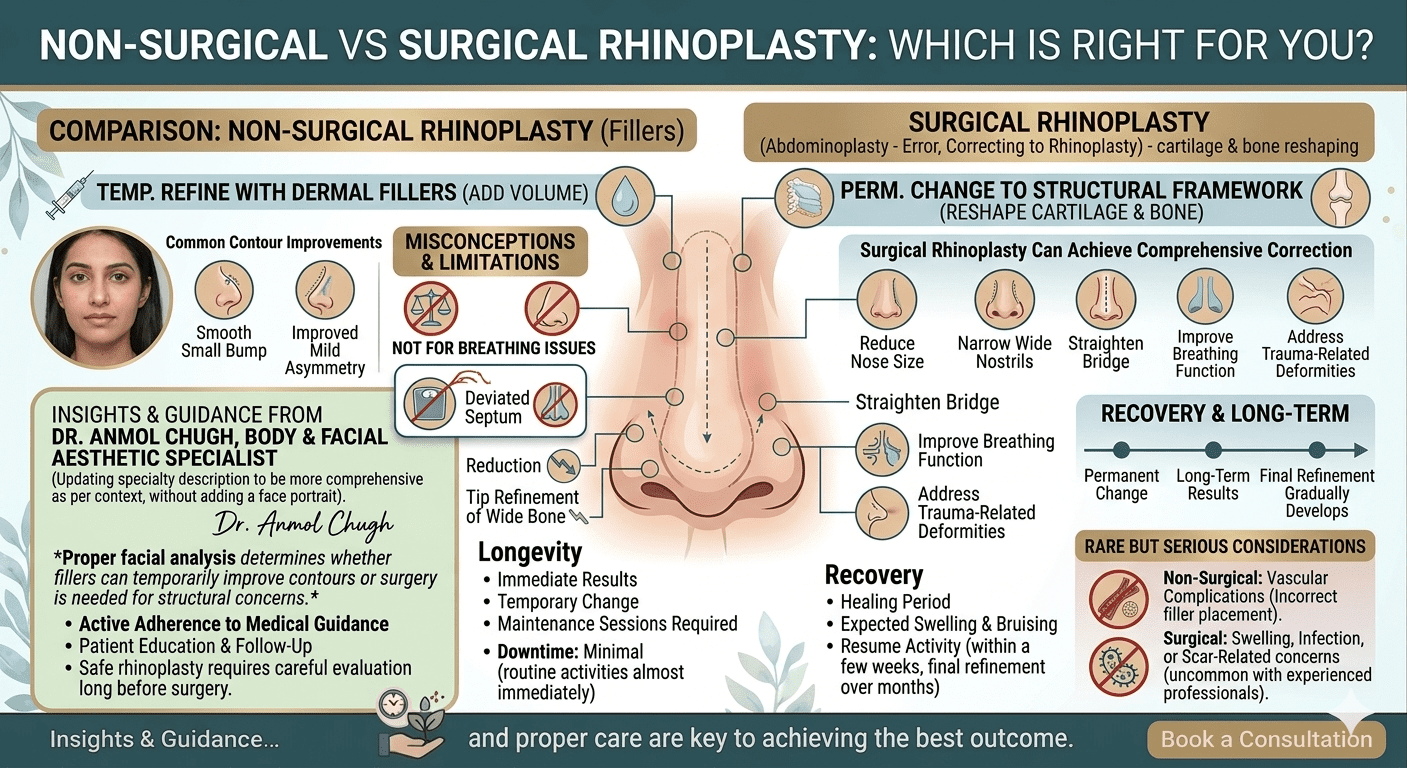
Non-surgical rhinoplasty uses injectable fillers to temporarily improve minor contour irregularities, while surgical rhinoplasty permanently reshapes the bone and cartilage of the nose.
If the concern is small contour refinement, fillers may help. If the goal is size reduction, structural correction, or breathing improvement, surgery is usually required.
Understanding the Real Difference Between the Two
The biggest difference lies in what is actually being changed.
Non-surgical rhinoplasty works by adding volume to selected areas using dermal fillers. Surgical rhinoplasty works by reshaping the internal framework of the nose, including cartilage and bone.
This distinction is extremely important because adding volume can improve some imperfections, but it cannot reduce or structurally rebuild the nose.
👉 Learn more about facial aesthetic procedures.
According to Dr. Anmol Chugh, understanding whether a concern is “surface-level” or “structural” is the key to selecting the right treatment and avoiding unrealistic expectations.
What Non-Surgical Rhinoplasty Can Improve
Non-surgical rhinoplasty, often called a “liquid nose job,” is best suited for subtle refinements rather than major transformations.
It can help:
- Smooth out a small bump on the bridge
- Improve mild asymmetry
- Create the illusion of a straighter profile
- Add definition to a flat bridge
- Slightly lift the nasal tip
Because fillers are used strategically, the procedure can create a more balanced appearance without surgery. Results are visible almost immediately, and downtime is minimal.
Many patients choose this option because it is quick, less intimidating, and does not require recovery similar to surgery.
Also read: 5 Things You Must Know Before Getting a Non-Surgical Nose Job
The Limitations of Non-Surgical Rhinoplasty
This is where many misconceptions begin.
Although fillers can improve contour, they cannot make the nose smaller. In fact, fillers work by adding volume, which means the nose may actually appear slightly larger in certain cases.
Non-surgical rhinoplasty also cannot:
- Correct breathing problems
- Fix a deviated septum
- Reduce wide nasal bones
- Significantly refine thick nasal tips
- Address major structural deformities
Results are temporary and usually last several months before maintenance is needed.
I often explain to patients that fillers are excellent for refinement, not reconstruction. Patients seeking dramatic reshaping or permanent reduction usually achieve better satisfaction with surgical rhinoplasty.
What Surgical Rhinoplasty Can Achieve
Surgical rhinoplasty offers a much broader range of correction because it changes the actual framework of the nose.
The procedure can:
- Reduce nose size
- Refine the nasal tip
- Straighten the bridge
- Narrow wide nostrils
- Correct asymmetry
- Improve breathing function
- Address trauma-related deformities
Unlike fillers, surgery can both add and remove structure depending on the requirement.
👉 Explore related body contouring procedures.
This makes surgical rhinoplasty the preferred option for patients seeking permanent or more comprehensive changes.
Who Is a Good Candidate for Non-Surgical Rhinoplasty?
Non-surgical rhinoplasty is usually ideal for patients who:
- Have minor contour irregularities
- Want subtle enhancement
- Prefer temporary results
- Are not emotionally ready for surgery
- Want minimal downtime
It can also help patients “visualize” potential improvements before committing to permanent surgery.
However, proper patient selection is essential. Not every nose is suitable for fillers.
Also read: 6 Amazing Benefits of Non-Surgical Rhinoplasty with Fillers
Who Is a Good Candidate for Surgical Rhinoplasty?
Surgical rhinoplasty is generally recommended for patients who:
- Want permanent changes
- Need structural correction
- Have breathing difficulty
- Want nose reduction
- Desire significant reshaping
It is also the only effective option for many post-traumatic or congenital nasal concerns.
According to Dr. Anmol Chugh, surgical rhinoplasty should always aim to preserve facial harmony rather than create an artificial or overdone appearance.
Comparing Longevity and Results
One of the most important differences between the two procedures is longevity.
Non-Surgical Rhinoplasty
- Immediate improvement
- Temporary results
- Maintenance sessions required
Surgical Rhinoplasty
- Long-term structural change
- Permanent results
- Final refinement develops gradually over time
Patients who want flexibility and reversibility may prefer fillers, while those seeking long-term correction often lean toward surgery.
Recovery and Downtime
Non-Surgical Rhinoplasty Recovery
Most patients return to routine activities almost immediately. Mild swelling or redness usually settles within a short period.
Surgical Rhinoplasty Recovery
Surgery requires a healing period. Swelling, bruising, and temporary changes are expected during recovery. Although patients usually resume normal activities within a few weeks, final refinement may continue for several months.
Understanding this healing timeline is important for avoiding unnecessary anxiety after surgery.
Safety Considerations
Both procedures are considered safe when performed correctly, but each carries different types of risks.
Non-surgical rhinoplasty involves delicate blood vessels in the nose, making proper injection technique extremely important. Incorrect filler placement can lead to vascular complications.
Surgical rhinoplasty carries standard surgical risks such as swelling, infection, or scar-related concerns, though serious complications are uncommon when performed by experienced professionals.
👉 Learn more about cosmetic surgery safety.
Choosing an experienced specialist like Dr. Anmol Chugh significantly improves both safety and aesthetic outcomes.
Common Mistakes Patients Make
One of the most common mistakes is assuming fillers can completely replace surgery.
This often leads to repeated temporary treatments without addressing the actual structural concern. Another mistake is expecting surgical perfection immediately after the procedure, without understanding the swelling and healing process.
Clear communication and realistic expectations are essential for satisfaction.
Also read: 9 Ways a Liquid Rhinoplasty Can Improve Your Facial Profile
The Emotional Side of Rhinoplasty
Rhinoplasty is not only about changing a feature it often affects confidence, self-image, and social comfort.
Because the nose plays such a central role in facial appearance, even small improvements can create a noticeable psychological impact. However, the goal should always be enhancement, not complete facial alteration.
Natural-looking outcomes almost always age better and appear more harmonious over time.
Conclusion
Non-surgical and surgical rhinoplasty are designed for very different purposes. One is a temporary contouring option, while the other is a permanent structural procedure.
Neither approach is universally “better.” The right option depends entirely on the anatomy of your nose, the complexity of your concern, and your long-term goals.
With proper evaluation and expert guidance from Dr. Anmol Chugh, patients can choose the most suitable approach and achieve results that look balanced, refined, and natural.
Book a Consultation
If you are unsure whether non-surgical or surgical rhinoplasty is right for you, a personalized consultation can help you understand your options clearly.
You will be able to:
- Assess your nasal structure and facial balance
- Understand realistic treatment outcomes
- Compare temporary vs permanent correction options
- Create a personalized treatment plan
👉 Book your consultation here:
Medically Reviewed By
Dr. Anmol ChughQualifications: MBBS, MS, MCh (Plastic Surgery)
Experience: 16+ Years in Plastic & Aesthetic Surgery
Review Date: 27 Apr 2026
This article has been medically reviewed for accuracy and patient safety.