What Can Go Wrong in Liposuction? (Risks Explained)
Liposuction is widely known as one of the most effective procedures for reshaping stubborn body fat that does not respond to exercise or dieting. From the abdomen and flanks to the thighs and chest, it has helped countless patients achieve a more balanced and proportionate body contour.
But despite its popularity, one question remains extremely common during consultations:
“What if something goes wrong?”
This concern is understandable. Social media often highlights dramatic transformations while rarely discussing the healing process, limitations, or possible complications. On the other hand, internet horror stories can create unnecessary fear and confusion.
The reality is more balanced. Liposuction is generally a safe procedure when performed correctly, but like any surgery, it comes with risks that patients should understand before making a decision. Knowing these risks does not mean you should fear the procedure, it simply helps you approach it with realistic expectations and proper awareness.
This article is based on clinical insights and experience from Dr. Anmol Chugh, who performs advanced body contouring procedures with a strong focus on safety, precision, and natural-looking outcomes.
In my clinical practice, many patients arrive with the belief that liposuction is a “simple fat removal procedure” with no recovery or risks involved. One of the most important parts of my consultation is helping them understand that proper planning and realistic expectations are essential for both safety and satisfaction.
Table of Contents
- What Can Go Wrong in Liposuction? (Quick Answer)
- Understanding Liposuction Safety
- The Most Common Liposuction Risks
- Risks Related to Skin Quality
- Rare but Serious Complications
- Who Has a Higher Chance of Complications?
- How Complications Can Be Reduced
- The Importance of Realistic Expectations
- Balancing Risks and Benefits
- Conclusion
- Book a Consultation
What Can Go Wrong in Liposuction? (Quick Answer)
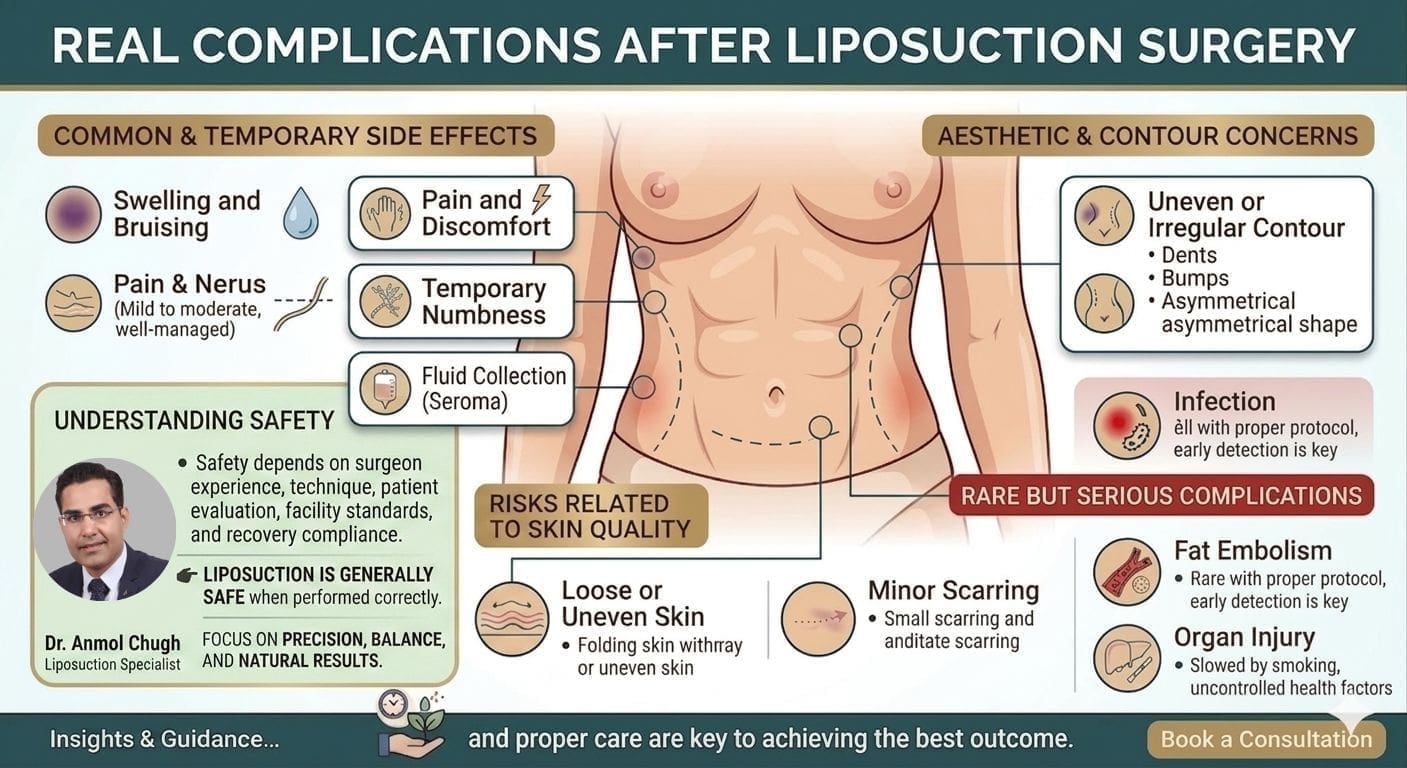
Liposuction is generally safe when performed by a qualified and experienced surgeon, but possible complications include uneven contour, prolonged swelling, infection, fluid collection, skin irregularities, and, in rare cases, more serious medical complications.
Most of these risks can be significantly minimized through careful patient selection, proper surgical technique, and structured post-operative care.
Understanding Liposuction Safety
Before discussing complications, it is important to understand that liposuction itself is not inherently dangerous. Problems usually arise when important medical principles are ignored.
The safety of the procedure depends on several factors, including:
- The surgeon’s experience and technique
- Proper patient evaluation
- The amount of fat being removed
- Surgical facility standards
- Recovery and aftercare compliance
👉 Learn more about liposuction treatment.
In clinical practice, Dr. Anmol Chugh emphasizes that safe liposuction begins long before the surgery itself. Proper assessment of skin quality, fat distribution, medical history, and patient expectations plays a major role in reducing complications.
The Most Common Liposuction Risks
Most side effects after liposuction are temporary and manageable. However, understanding them in advance helps patients recover more confidently.
Uneven or Irregular Contour
One of the most commonly discussed concerns is uneven contour after healing.
If fat is removed unevenly, patients may notice dents, lumps, asymmetry, or irregular body shape. This usually happens due to aggressive fat removal or poor technique.
Achieving a smooth contour requires precision, balance, and understanding of body proportions, not simply removing as much fat as possible.
Swelling and Bruising
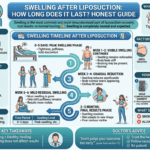
Swelling is a completely normal part of recovery and often lasts longer than patients expect.
While most swelling improves within weeks, subtle swelling can continue for several months before the final contour becomes visible. Bruising is also common during the initial healing phase.
Patients who understand this timeline beforehand are usually far less anxious during recovery.
Fluid Collection (Seroma)
Sometimes, fluid can accumulate under the skin after surgery. This is known as a seroma.
Patients may notice localized swelling or a fluid-like sensation in the treated area. While usually not dangerous, it may require drainage if significant.
Compression garments and proper post-operative care help reduce this risk substantially.
Temporary Numbness or Altered Sensation
After liposuction, some patients notice numbness, tingling, or altered sensation in treated areas.
This occurs because small nerves beneath the skin become temporarily irritated during fat removal. In most cases, sensation gradually improves over time without intervention.
Risks Related to Skin Quality
Not every complication is related to the surgery itself. Sometimes the issue lies in how the skin responds afterward.
Loose or Uneven Skin
Liposuction removes fat, but it does not automatically guarantee skin tightening.
Patients with poor skin elasticity may notice mild looseness, waviness, or irregular contraction after fat removal. This is especially common after major weight fluctuations or with aging skin.
👉 Explore skin tightening treatments.
In some cases, combining liposuction with skin tightening technologies or surgical contouring provides better results.
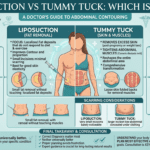
👉 Read about tummy tuck surgery for patients with excess skin concerns.
Minor Scarring
Liposuction uses very small incisions, so scars are generally minimal. However, individual healing patterns vary, and some patients may develop slightly more visible scars than others.
Most scars fade significantly over time and are usually hidden in natural body creases whenever possible.
Rare but Serious Complications
Although uncommon, certain complications are medically important and should be discussed honestly.
Infection
Infection after liposuction is rare when proper surgical hygiene and aftercare are maintained. However, untreated infections can become serious if ignored.
Early symptoms may include increasing redness, pain, fever, or discharge from incision sites. Prompt treatment is essential.
Fat Embolism
Fat embolism is a rare but serious condition where fat particles enter the bloodstream and affect circulation.
This complication is uncommon and is significantly reduced when the procedure is performed carefully under proper medical standards.
Organ Injury
Very rarely, surgical instruments inserted too deeply may injure internal structures. This is considered extremely uncommon and is generally associated with improper technique or unqualified practitioners.
Anesthesia Risks
As with any surgical procedure, anesthesia carries certain risks, particularly in patients with underlying medical conditions.
This is why a proper medical evaluation before surgery is essential.
Who Has a Higher Chance of Complications?
Certain individuals naturally carry a higher risk profile.
This may include:
- Smokers
- Patients with uncontrolled diabetes or medical conditions
- Individuals with poor skin elasticity
- Patients seeking unrealistic transformations
- Those undergoing excessively large-volume liposuction
Careful evaluation helps determine whether liposuction is suitable and how safely it can be performed.
How Complications Can Be Reduced
The most effective way to reduce risk is through proper surgeon selection and responsible surgical planning.
An experienced surgeon focuses not only on removing fat but also on preserving body balance, skin quality, and long-term safety.
👉 Explore additional body contouring procedures.
According to Dr. Anmol Chugh, complications are far less common when patients receive detailed evaluation, realistic counseling, and structured follow-up care.
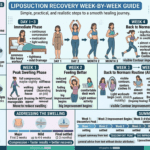
In my experience, patients who strictly follow recovery instructions, especially regarding compression garments, movement restrictions, and follow-up visits, usually heal more smoothly and achieve better contour outcomes.
The Importance of Realistic Expectations
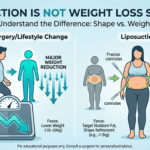
One of the biggest misunderstandings about liposuction is the belief that it is a weight-loss procedure.
Liposuction is designed to improve body shape and contour, not replace healthy lifestyle habits. Patients expecting dramatic weight reduction or “perfect” bodies often feel disappointed despite technically successful surgery.
Understanding the real purpose of liposuction helps patients feel happier and more confident with their results.
👉 You may also want to read about gynecomastia surgery and male body contouring options.
Balancing Risks and Benefits
Every surgical procedure involves some level of risk. The goal is not to pretend risk does not exist, but to minimize it responsibly.
For the right candidate, liposuction can significantly improve body proportions, clothing fit, confidence, and overall self-image.
When performed under proper medical guidance, the likelihood of severe complications remains low, while the benefits can be long-lasting and highly rewarding.
Conclusion
Liposuction is a safe and effective body contouring procedure when performed under the right conditions. While complications can occur, most are temporary, manageable, and significantly reduced through proper planning and expert care.
Understanding the possible risks helps patients make informed decisions instead of relying on fear, assumptions, or misleading online information.
With expert guidance from Dr. Anmol Chugh, patients can approach liposuction with greater confidence, realistic expectations, and a clear understanding of both safety and results.
Book a Consultation
If you are considering liposuction and want to understand your suitability, risks, and expected results in detail, a personalized consultation can help you make a confident decision.
You will be able to:
- Understand whether liposuction is right for you
- Discuss potential risks and recovery
- Create a safe and personalized treatment plan
👉 Book your consultation here:
Medically Reviewed By
Dr. Anmol ChughQualifications: MBBS, MS, MCh (Plastic Surgery)
Experience: 16+ Years in Plastic & Aesthetic Surgery
Review Date: 26 Apr 2026
This article has been medically reviewed for accuracy and patient safety.