Can Blepharoplasty Improve Vision Problems?
Many people think blepharoplasty (eyelid surgery) is only a cosmetic procedure that helps patients look younger. While it certainly improves the appearance of tired or drooping eyes, it can also provide important functional benefits.
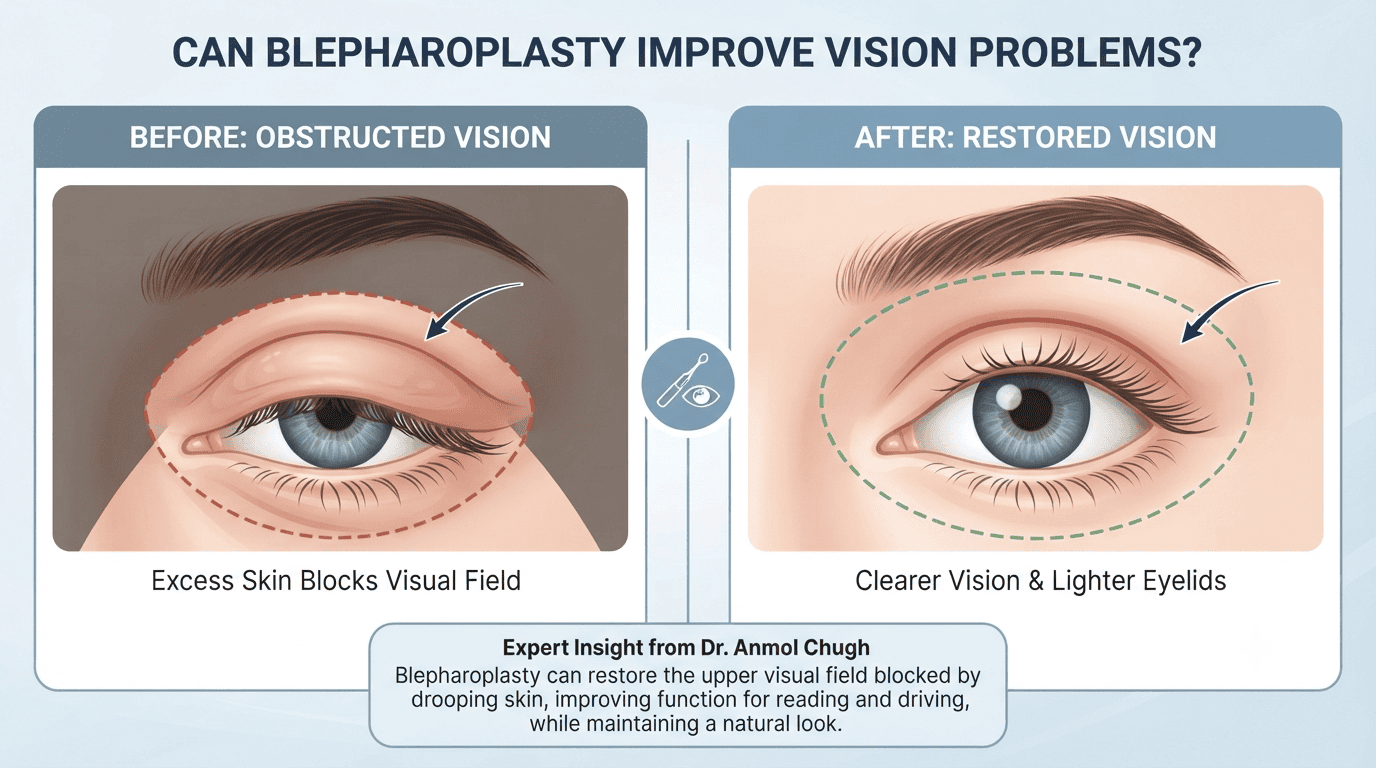
For some individuals, excess upper eyelid skin becomes so heavy that it hangs over the eyelashes and blocks part of the visual field. This can make everyday activities such as reading, driving, or using a computer more difficult.
One of the most common questions patients ask is:
“Can blepharoplasty actually improve my vision?”
The answer is yes, but only when vision problems are caused by drooping upper eyelids or excess eyelid skin.
In this guide, Dr. Anmol Chugh explains how functional blepharoplasty works, who may benefit from it, and what results patients can realistically expect.
Table of Contents
- Quick Answer
- What Is Blepharoplasty?
- How Can Droopy Eyelids Affect Vision?
- Can Blepharoplasty Improve Vision?
- Who Is a Good Candidate?
- When Blepharoplasty Will Not Improve Vision
- Functional vs Cosmetic Blepharoplasty
- What Happens During Surgery?
- Recovery After Blepharoplasty
- Dr. Anmol Chugh’s Clinical Perspective
- Common Mistakes Patients Make
- Recovery Protocol Followed at Our Centre
- Safety Checklist
- Who Should Not Undergo Blepharoplasty?
- What I Tell My Patients During Consultation
- Frequently Asked Questions
- Final Thoughts
Quick Answer
Yes.
Upper eyelid blepharoplasty can improve vision when excess eyelid skin blocks the upper or side visual field.
The surgery removes redundant skin and, when necessary, repositions underlying tissues to create a clearer field of vision.
However, blepharoplasty does not treat vision problems caused by eye diseases such as cataracts, glaucoma, retinal disorders, or refractive errors.
What Is Blepharoplasty?
Blepharoplasty is a surgical procedure that improves the appearance and, in some cases, the function of the eyelids.
Depending on the patient’s needs, surgery may involve:
- Removing excess skin
- Removing or repositioning fat
- Tightening supporting tissues
- Improving eyelid contour
The procedure may involve:
- Upper eyelids
- Lower eyelids
- Both upper and lower eyelids
How Can Droopy Eyelids Affect Vision?
As we age, the skin gradually loses collagen and elasticity.
The upper eyelids may begin to droop because of:
- Excess skin
- Weak eyelid muscles
- Loss of tissue support
- Natural ageing
When enough skin hangs over the eyelashes, it can partially block the upper visual field.
Patients commonly notice:
- Difficulty seeing overhead
- Reduced peripheral vision
- Needing to raise their eyebrows constantly
- Tilting the head backward to see clearly
- Eye fatigue during reading or driving
Can Blepharoplasty Improve Vision?
For appropriate patients, yes.
Removing excess upper eyelid skin allows more light to enter the eye and restores the blocked portion of the visual field.
Many patients notice improvements in:
- Reading
- Driving
- Computer work
- Watching television
- Walking safely
- Daily comfort
Several clinical studies have shown measurable improvement in visual field testing after functional upper eyelid surgery.
Who Is a Good Candidate?
Functional blepharoplasty may benefit patients who have:
- Heavy upper eyelids
- Excess eyelid skin resting on the eyelashes
- Reduced upper visual field
- Difficulty keeping the eyes fully open
- Brow strain from constantly lifting the eyelids
Candidates should also be in good general health and have realistic expectations.
Also Read: Everything You Should Know About Eyelid Surgery (Blepharoplasty)
When Blepharoplasty Will Not Improve Vision
Blepharoplasty cannot correct vision problems caused by:
- Cataracts
- Glaucoma
- Macular degeneration
- Retinal disease
- Dry eye disease alone
- Nearsightedness or farsightedness
- Astigmatism
In these situations, an ophthalmologist may recommend other treatments.
Functional vs Cosmetic Blepharoplasty
Although the procedure may look similar, the purpose differs.
Functional Blepharoplasty
Performed to improve eyelid function and restore the visual field.
Common reasons include:
- Vision obstruction
- Heavy eyelids
- Functional impairment
Cosmetic Blepharoplasty
Performed primarily to improve appearance.
It helps reduce:
- Puffy eyelids
- Loose skin
- Eye bags
- Signs of ageing
Many patients receive both functional and cosmetic benefits from the same surgery.
What Happens During Surgery?
Blepharoplasty is usually performed as a day-care procedure.
The general steps include:
- Careful marking of excess skin
- Local or general anaesthesia
- Removal of excess skin
- Removal or repositioning of fat when necessary
- Fine closure within the natural eyelid crease
The incision is carefully placed to minimize visible scarring.
Recovery After Blepharoplasty
Recovery varies slightly between patients.
Most people experience:
First Week
- Mild swelling
- Bruising
- Tightness
- Temporary blurred vision from ointments
2–3 Weeks
- Swelling gradually improves
- Daily activities become easier
Several Months
- Final healing
- Scar maturation
- Improved eyelid contour
Most patients return to light activities within one to two weeks.
Also Read: Eyelid Surgery Before and After: How Blepharoplasty Refreshes the Face
Dr. Anmol Chugh’s Clinical Perspective
Many patients are surprised to learn that eyelid surgery is sometimes performed for functional reasons rather than cosmetic ones.
When excess upper eyelid skin blocks vision, removing that tissue can make everyday activities much more comfortable.
The goal is not simply to make the eyes appear younger. It is to restore a natural eyelid position while preserving normal eye function and maintaining facial harmony.
Real Blepharoplasty Patient Result

See More Blepharoplasty Patient Results in Our Before & After Gallery.
Common Mistakes Patients Make
Assuming Every Droopy Eyelid Needs Surgery
Not all eyelid heaviness requires blepharoplasty.
A proper examination determines whether excess skin, muscle weakness, or another condition is responsible.
Expecting Better Eyesight
Blepharoplasty improves the visual field but does not improve the eye’s focusing ability.
Patients who wear glasses usually continue to need them after surgery.
Waiting Until Vision Is Significantly Affected
Earlier evaluation often allows treatment before symptoms become more troublesome.
Ignoring Dry Eye Symptoms
Patients with dry eyes should discuss this during consultation so treatment can be planned appropriately.
Choosing Surgery Based Only on Cost
Experience is particularly important because eyelid surgery requires precision and careful attention to both appearance and function.
Recovery Protocol Followed at Our Centre
Recovery instructions are customized for every patient.
Our general protocol includes:
- Cold compresses during the first 48 hours
- Head elevation while sleeping
- Lubricating eye drops if required
- Temporary restriction of strenuous activities
- Careful incision cleaning
- Scheduled follow-up appointments
- Monitoring healing and eyelid position
Safety Checklist
Before surgery:
✔ Complete an eye evaluation if recommended
✔ Inform your surgeon about previous eye surgery
✔ Discuss all medications
✔ Stop smoking if advised
✔ Arrange transportation after surgery
✔ Follow all recovery instructions
✔ Attend follow-up appointments
Who Should Not Undergo Blepharoplasty?
Blepharoplasty may not be appropriate for patients who have:
- Active eye infections
- Uncontrolled glaucoma
- Certain severe dry eye conditions
- Uncontrolled medical illnesses
- Unrealistic expectations
A detailed consultation helps determine whether surgery is appropriate.
What I Tell My Patients During Consultation
I always explain that the goal of functional blepharoplasty is not to improve the quality of eyesight itself.
Instead, it improves the amount of vision that is physically blocked by heavy eyelids.
When patients understand this distinction, they usually have realistic expectations and are very satisfied with the outcome.
Frequently Asked Questions
Can eyelid surgery improve my eyesight?
Blepharoplasty improves the visual field when excess eyelid skin blocks vision, but it does not treat eye diseases or eliminate the need for glasses.
How do I know if my vision is blocked by my eyelids?
If you constantly lift your eyebrows, tilt your head back, or notice better vision when manually lifting your eyelids, you may benefit from an evaluation.
Is functional blepharoplasty different from cosmetic blepharoplasty?
The surgical technique is often similar, but functional surgery is performed to improve vision rather than appearance alone.
How long does recovery take?
Most patients return to light daily activities within one to two weeks, while complete healing continues over several months.
Will the scars be visible?
Incisions are usually placed within the natural upper eyelid crease, making scars difficult to notice after healing.
Final Thoughts
Blepharoplasty is more than a cosmetic procedure. For patients with heavy upper eyelids that obstruct the visual field, functional eyelid surgery can improve daily activities such as reading, driving, and computer work while also creating a more refreshed appearance.
The key is determining whether your vision problems are actually caused by excess eyelid skin. During a personalized consultation, Dr. Anmol Chugh carefully evaluates your eyelids, visual concerns, and facial anatomy to recommend the most appropriate treatment for both function and appearance.
Related Procedures
- Blepharoplasty (Eyelid Surgery)
- Facial Fat Transfer
- Facelift Surgery
- Skin Tightening Treatments
- Non-Surgical Facial Rejuvenation
References
- American Society of Plastic Surgeons. Blepharoplasty (Eyelid Surgery).
https://www.plasticsurgery.org/cosmetic-procedures/eyelid-surgery - American Academy of Ophthalmology. Functional Blepharoplasty.
https://www.aao.org - American Society of Ophthalmic Plastic and Reconstructive Surgery (ASOPRS). Blepharoplasty Information.
https://www.asoprs.org - Cahill KV, Bradley EA, Meyer DR, et al. Functional indications for upper eyelid ptosis and blepharoplasty surgery. Ophthalmology. 2011;118(12):2510–2517.
https://doi.org/10.1016/j.ophtha.2011.06.009 - American Academy of Ophthalmology. Dermatochalasis and Visual Field Loss.
https://www.aao.org/eye-health - Finsterer J. Ptosis: causes, presentation, and management. Aesthetic Plastic Surgery. 2003;27(3):193–204.
https://doi.org/10.1007/s00266-003-0127-5 - International Society of Aesthetic Plastic Surgery (ISAPS). Patient Safety Resources.
https://www.isaps.org
Medically Reviewed By
Dr. Anmol ChughQualifications: MBBS, MS, MCh (Plastic Surgery)
Experience: 16+ Years in Plastic & Aesthetic Surgery
Review Date: 22 Jul 2026
This article has been medically reviewed for accuracy and patient safety.