
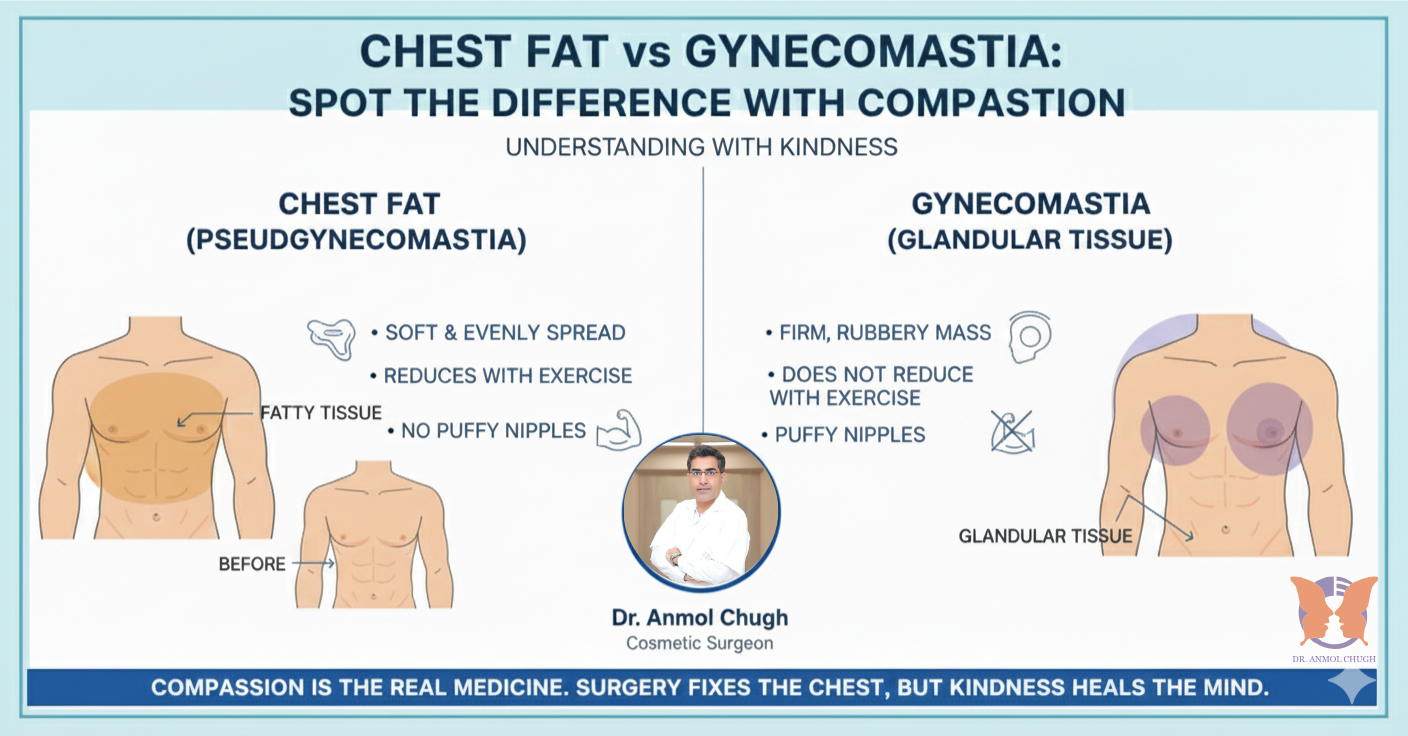
Chest Fat vs Gynecomastia: Spot the Difference with Compassion
For many men, changes in the chest area can feel confusing and sometimes embarrassing.
Some see puffiness around the nipples. Others notice their chest looks round or soft even when they exercise regularly.
Family members may say, “Lose weight, and it will go away.”
Friends may joke without understanding the pain behind it.
But here’s the truth:
Not all chest fullness is the same.
There are two very different conditions:
- Chest Fat (pseudogynecomastia)
- Gynecomastia (glandular breast tissue growth)
One is related to fat.
The other is a medical condition.
And both deserve compassion, not judgment.
As Dr. Anmol Chugh, expert plastic surgeon at CK Birla Hospital, Gurugram, says:
“Men often suffer silently because society doesn’t talk about gynecomastia. The first step to healing is understanding, with kindness.”
This blog will help you gently and clearly understand the difference, so you or your loved one can make informed, confident decisions.
What Is Chest Fat? (Pseudogynecomastia)
Chest fat is simply fatty tissue that collects on and around the chest.
It usually happens because of:
- Weight gain
- Slow metabolism
- Lack of exercise
- Diet high in sugar or fat
- Genetics
How chest fat feels:
- Soft
- Evenly spread
- Moves easily under the skin
How it looks:
- The chest appears round or bulky
- Nipples may face downward
- Often changes when weight changes
Chest fat can reduce with:
- Cardio
- Strength training
- Calorie control
- Weight loss
But chest fat does NOT create the firm “puffy nipples” look.
What Is Gynecomastia? A Medical Condition
Gynecomastia is completely different.
It is not fat.
It is glandular tissue that grows behind the nipple due to hormonal imbalance.
This can happen at any age, puberty, adulthood, or older age.
Gynecomastia occurs when:
- Estrogen increases
- Testosterone decreases
- The body creates extra breast gland tissue
How gynecomastia feels:
- Firm or rubbery mass under the nipple
- Sometimes painful or sensitive
- Nipple area looks swollen or puffy
How it looks:
- Puffy nipples
- Pointing outward
- Disc-shaped swelling beneath the areola
- Chest may look feminine or rounded even in slim men
No amount of exercise or fat loss removes gland tissue.
This is why many men say:
“I go to the gym every day, but this part never changes.”
It’s not their fault, it’s biology.
Chest Fat vs Gynecomastia, The Clear Differences
Here is the easiest, most compassionate way to differentiate the two:
| Feature | Chest Fat | Gynecomastia |
| Type of tissue | Fat | Gland |
| Feel | Soft | Firm or rubbery |
| Change with exercise? | Yes | No |
| Puffy nipples | Rare | Very common |
| Pain or tenderness | Rare | Common |
| Symmetry | Often uneven | Usually symmetrical |
| Cause | Weight • diet • genes | Hormones • meds • puberty |
Understanding this difference helps men stop blaming themselves for something that is not in their control.
Common Causes of Gynecomastia
Gynecomastia happens when hormones shift.
This can be due to:
Puberty Hormones
Teen boys experience temporary hormonal imbalance.
This can cause gland growth.
Weight Gain
Fat increases estrogen production, which increases gland formation.
Genetics
If a family member had it, you may too.
Medications
Some medicines for:
- acidity
- depression
- blood pressure
- muscle building
- hair loss
…can trigger gynecomastia.
Steroids or Supplements
Bodybuilding steroids and contaminated protein powders are major causes for young men.
Medical Conditions
Rare thyroid, liver, or testicular conditions can influence hormones.
Once the gland grows, it stays unless surgically removed.
Why This Condition Hurts Emotionally
Many men with gynecomastia never take off their shirt in public.
Some avoid gyms, beaches, or swimming.
Others wear oversized clothing to hide the chest area.
Some men experience:
- Body shame
- Self-consciousness
- Difficulty in relationships
- Anxiety
- Isolation
As Dr. Chugh shares:
“Gynecomastia affects the mind much more than the body. The emotional weight is often heavier than the physical one.”
This is why compassion is essential when discussing this topic with any man, younger or older.
Can Gym Fix Gynecomastia?
This is the biggest myth.
Gym can reduce:
✔ chest fat
✔ overall weight
✔ muscle imbalance
Gym cannot reduce:
❌ gland tissue
❌ puffy nipples
❌ disc-shaped swelling
❌ hormonal breast growth
This is why even bodybuilders get gynecomastia.
If a man has gland tissue, only surgery can remove it permanently.
How Treatment Works, Modern Gynecomastia Surgery
At CK Birla Hospital, Gurugram, Dr. Anmol Chugh uses advanced, minimally invasive techniques.
Step 1: Liposuction
Removes fat around the chest for a clean contour.
Step 2: Gland Removal
A small incision on the edge of the areola.
The gland is removed completely, the key to permanent results.
Step 3: Sculpting
Chest is shaped to look masculine and flat.
Step 4: Skin Tightening (if needed)
For high-grade or weight-loss cases.
Recovery:
- Back to work: 2–3 days
- Gym: 3–4 weeks
- Final shape: 6–12 weeks
The scar? Almost invisible.
Why Men Should Not Feel Ashamed
Gynecomastia is:
- Common
- Hormonal
- Scientific
- Treatable
- Not their fault
- Not due to laziness
No man deserves teasing, shame, or silence.
This is why Dr. Chugh approaches every case with sensitivity and respect.
He often tells young patients:
“Your worth has nothing to do with your chest. Let’s fix the medical issue so you can live fully again.”
When Families Understand, Healing Begins
When parents, siblings, or partners learn the real science, they stop saying things like:
- “Just lose weight.”
- “Ignore it.”
- “It’s normal.”
- “Don’t waste money on surgery.”
Instead, they offer support.
They help their loved one feel heard and validated.
They encourage proper diagnosis and treatment.
Support turns shame into confidence.
Why Choose Dr. Anmol Chugh for Gynecomastia Treatment
At CK Birla Hospital, Dr. Anmol Chugh is known for:
- Safe, scar-minimizing techniques
- Complete gland removal
- Natural masculine sculpting
- Quick, comfortable recovery
- Privacy and emotional care
His results focus on confidence, comfort, and long-term satisfaction.
Final Thoughts: Kindness Makes the Difference
Chest changes can be confusing.
Gynecomastia can be painful, physically and emotionally.
And many men feel too embarrassed to talk about it.
But with the right knowledge and compassionate care, everything changes.
If the chest has soft fat, lifestyle changes can help.
If the chest has gland tissue, surgery is the only effective solution.
Either way,
the first step is not diet, gym, or treatment.
The first step is understanding.
Because when men feel understood instead of judged, healing becomes easier.
As Dr. Chugh says:
“Compassion is the real medicine. Surgery fixes the chest, but kindness heals the mind.”