Minimizing Scars in Plastic Surgery: Real Options Explained
One of the most common concerns patients have before undergoing any cosmetic or reconstructive procedure is the fear of visible scarring. While the goal of plastic surgery is to enhance appearance and restore confidence, the idea of trading one concern for another, such as noticeable scars, can create hesitation.
It is important to understand that scarring is a natural part of the healing process, not a complication. However, modern plastic surgery has evolved significantly, with advanced techniques and technologies designed to minimize scar visibility as much as possible.
The key lies in understanding what is realistically achievable, what factors influence scar formation, and what steps can be taken before, during, and after surgery to achieve the best outcome. This article is based on clinical insights and experience from Dr. Anmol Chugh, who specializes in aesthetic procedures with a focus on natural-looking results and optimized scar healing.
In my clinical practice, I often meet patients who are more worried about scars than the actual procedure itself. In many cases, once I explain how scars are planned and managed, their hesitation reduces significantly, and they feel more confident about moving forward.
Can Scars Be Completely Avoided in Plastic Surgery?
A common misconception is that plastic surgery can be completely scar-free. From a medical standpoint, this is not possible when the skin is surgically incised.
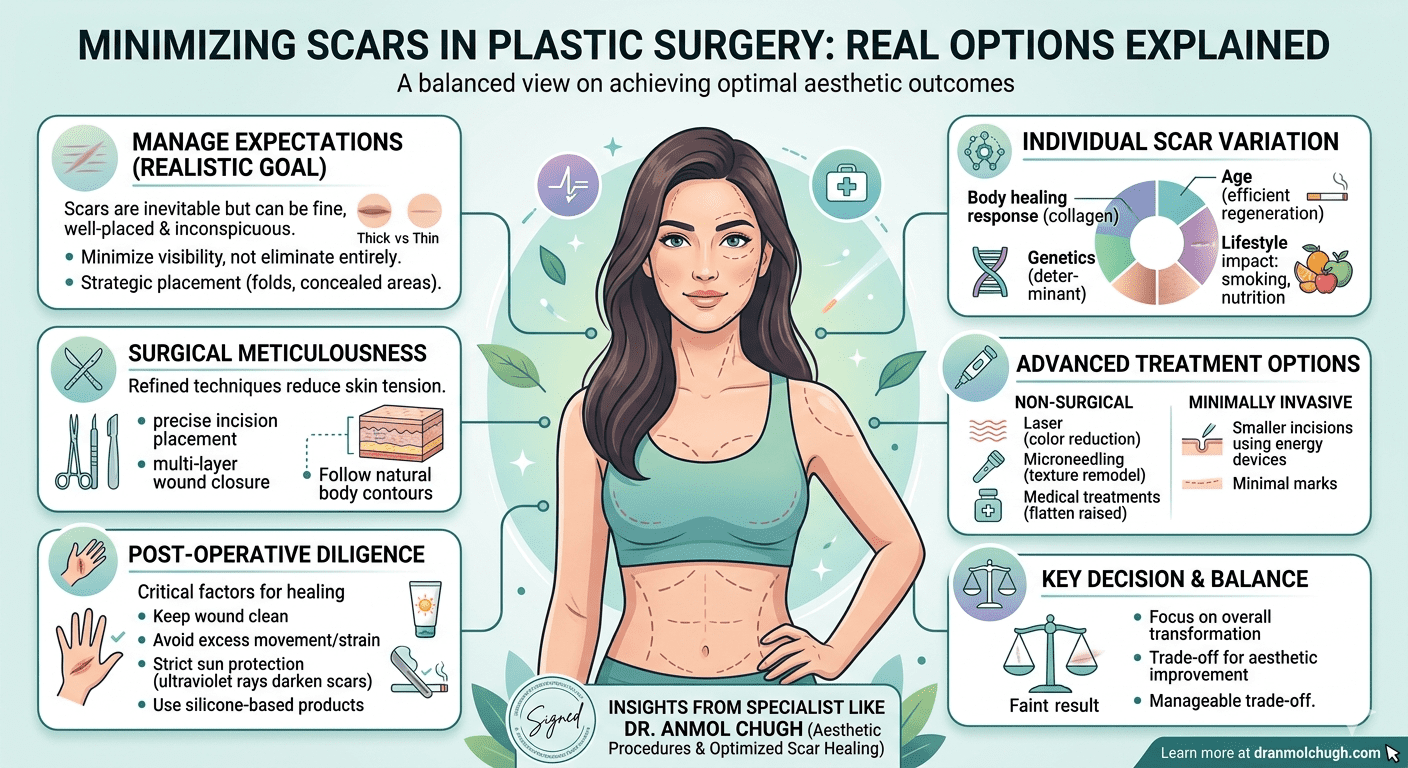
Any procedure that involves cutting the skin will result in some degree of scarring. However, the objective of modern plastic surgery is not to eliminate scars entirely, but to make them as fine, well-placed, and inconspicuous as possible.
In many cases, scars are strategically positioned along natural skin folds or in areas that can be easily concealed under clothing. Over time, with proper healing and care, these scars typically fade and become far less noticeable.
Why Do Some Scars Look Better Than Others?
Scar appearance varies widely between individuals, even when the same procedure is performed.
This variation is influenced by several biological and external factors. The body’s natural healing response plays a major role, particularly how collagen is produced and organized during the repair process. Genetics can determine whether a scar becomes thin and flat or thick and raised.
Skin type is another important consideration. Individuals with darker skin tones may be more prone to pigmentation changes or hypertrophic scars. Age also influences healing, as younger skin tends to regenerate more efficiently.
Lifestyle factors such as smoking, poor nutrition, and sun exposure can negatively impact healing and lead to more visible scars. Understanding these variables helps set realistic expectations and emphasizes the importance of personalized care.
Surgical Techniques That Help Minimize Scars
A significant part of scar minimization begins in the operating room.
Experienced surgeons use refined techniques to reduce tension on the skin, ensure precise incision placement, and close wounds in multiple layers. These methods promote better healing and reduce the risk of widened or thickened scars.
Incisions are carefully planned to follow natural contours of the body, making them less noticeable once healed. In procedures such as tummy tuck or breast surgery, scars are typically placed in areas that can be easily hidden.
👉 Learn more about body contouring procedures:
Tummy Tuck Surgery
According to Dr. Anmol Chugh, meticulous surgical technique combined with proper patient selection plays a crucial role in achieving optimal aesthetic outcomes.
The Role of Post-Operative Care
While surgical technique is important, the healing process continues long after the procedure is completed. Post-operative care is one of the most critical factors in determining how a scar will ultimately look.
Patients are usually advised to keep the wound clean, avoid excessive movement that may strain the incision, and follow all medical instructions carefully. Once the initial healing phase is complete, additional measures such as silicone-based products may be recommended to improve scar quality.
Sun protection is particularly important, as exposure to ultraviolet rays can darken scars and make them more noticeable. Consistent aftercare over several months is essential for achieving the best results.
Non-Surgical Treatments to Improve Scars
Even after a scar has formed, there are several non-surgical treatments that can help improve its appearance.
Technologies such as laser therapy can reduce redness and pigmentation, while microneedling can help remodel collagen and smooth out the texture. In some cases, specialized medical treatments may be used to flatten raised scars or reduce thickness.
👉 Explore advanced treatments:
Skin Tightening & Laser Treatments
These treatments do not remove scars completely, but they can make them significantly less visible and more consistent with the surrounding skin.
Minimally Invasive Approaches: Reducing the Need for Large Incisions
In recent years, minimally invasive techniques have gained popularity as they involve smaller incisions and therefore smaller scars.
Procedures such as BodyTite or FaceTite use tiny entry points to deliver energy beneath the skin, achieving fat reduction and skin tightening with minimal external marks. While these methods are not entirely scar-free, the marks are usually very small and often fade to the point of being barely noticeable.
👉 Learn more about contouring options:
Liposuction & Body Contouring
These approaches are particularly suitable for patients with mild to moderate concerns who wish to avoid larger surgical scars.
Managing Expectations: The Most Important Factor
One of the most important aspects of scar management is setting realistic expectations.
Patients often expect scars to disappear completely, but the goal is to make them as subtle and discreet as possible. Understanding that some degree of scarring is inevitable allows patients to focus on the overall improvement achieved through the procedure.
In my experience, patients who clearly understand this before surgery are significantly more satisfied with their final results, because they focus on the overall transformation rather than just the scar.
A well-healed scar that is thin, flat, and strategically placed is generally considered a successful outcome in plastic surgery.
When Scars Require Additional Treatment
In certain cases, scars may not heal as expected. Conditions such as hypertrophic scars or keloids can result in thicker or raised scars that are more noticeable.
These situations require specialized treatment, which may include medical therapy or advanced procedures to improve the appearance. Early intervention often leads to better outcomes, making regular follow-up with your surgeon essential.
Balancing Scars and Results
Plastic surgery is ultimately about achieving a balanced and harmonious result. While scars are a part of the process, they are usually a small trade-off compared to the overall transformation.
For many patients, the improvement in body contour, symmetry, and confidence far outweighs concerns about a faint scar. When procedures are performed correctly and followed by proper care, scars tend to become a minor and manageable aspect of the final result.
Under the care of an experienced specialist like Dr. Anmol Chugh, patients can expect both aesthetic improvement and thoughtful scar management.
Conclusion
Minimizing scars in plastic surgery is not about eliminating them completely, but about using the right combination of surgical expertise, post-operative care, and supportive treatments to achieve the best possible outcome.
Modern techniques allow scars to be placed discreetly, heal efficiently, and fade significantly over time. By understanding the process and following professional guidance, patients can approach surgery with confidence and realistic expectations.
Book a Consultation
If you are considering plastic surgery and are concerned about scarring, a personalized consultation can help address your concerns in detail.
You will gain clarity on:
- Expected scar placement
- Healing process and timeline
- Options to minimize scar visibility
👉 Book your consultation here:
https://dranmolchugh.com/contact/
Medically Reviewed By
Dr. Anmol ChughQualifications: MBBS, MS, MCh (Plastic Surgery)
Experience: 16+ Years in Plastic & Aesthetic Surgery
Review Date: 20 Apr 2026
This article has been medically reviewed for accuracy and patient safety.