Best Sleeping Position After Gynecomastia Surgery
Gynecomastia surgery can create a flatter, firmer, and more masculine chest contour. However, the surgery itself is only one part of the journey. Recovery plays a major role in achieving the best possible outcome, and one aspect that patients often overlook is sleeping position after gynecomastia surgery.
A question Dr. Anmol Chugh frequently hears during consultations is:
“How should I sleep after gynecomastia surgery?”
The answer is simple but extremely important.
Your sleeping position can influence swelling, comfort, healing, and even the quality of your final result during the early recovery period.
In this guide, we’ll discuss the best sleeping positions after gynecomastia surgery, common mistakes patients make, recovery recommendations, and practical tips for sleeping comfortably during the healing phase.
Table of Contents
- Quick Answer
- Why Sleeping Position Matters After Gynecomastia Surgery
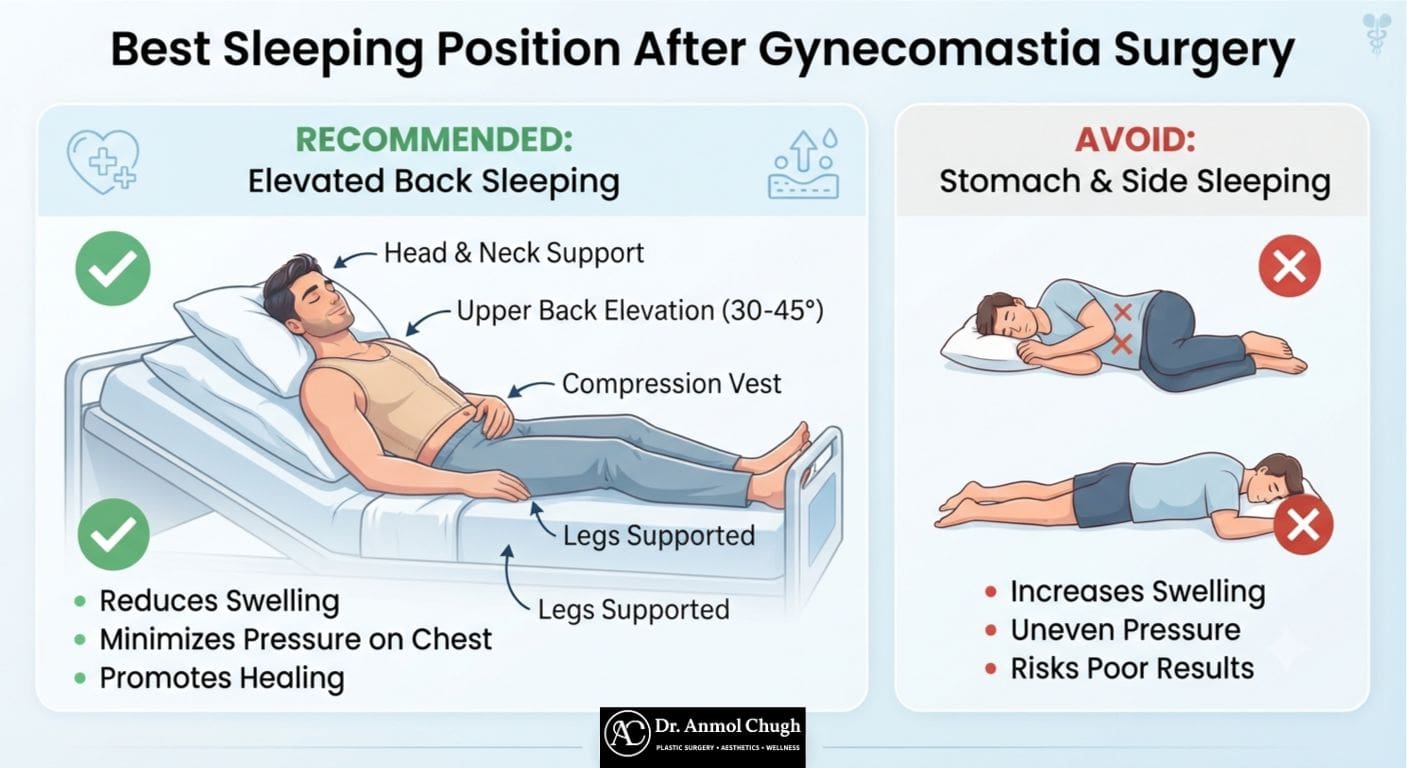
- The Best Sleeping Position: Elevated on Your Back
- How to Create the Ideal Sleeping Setup
- Why You Should Avoid Sleeping on Your Stomach
- Is Side Sleeping Allowed?
- What I Tell My Patients During Consultation
- Recovery Protocol Followed at Our Centre
- Common Mistakes Patients Make
- Safety Checklist for Better Sleep After Surgery
- Who Should Be Extra Careful?
- How Long Should You Sleep on Your Back?
- Before-and-After Recovery Example
- Final Thoughts
Quick Answer
The best sleeping position after gynecomastia surgery is:
✔ On your back
✔ With your upper body elevated at approximately 30–45 degrees
✔ While wearing your compression garment as instructed
Sleeping on your stomach or side should generally be avoided during the initial recovery period unless specifically approved by your surgeon.
Why Sleeping Position Matters After Gynecomastia Surgery
After surgery, your chest undergoes several healing processes simultaneously.
The body is:
- Reducing inflammation
- Repairing tissues
- Adapting to the new chest contour
- Managing swelling
- Re-establishing blood circulation
Poor sleeping positions can place unnecessary pressure on the chest and potentially interfere with these healing processes.
From Dr. Anmol Chugh’s clinical perspective, patients who follow proper sleeping recommendations often experience a smoother and more comfortable recovery.
The Best Sleeping Position: Elevated on Your Back
For most patients, sleeping on the back with the upper body elevated is the preferred position during the early recovery phase.
This position offers several benefits.
Helps Reduce Swelling
After surgery, fluid naturally accumulates in the treated area.
Keeping your chest elevated allows gravity to assist fluid drainage and can help reduce swelling more efficiently.
Many patients notice improved comfort and reduced morning puffiness when sleeping with elevation.
Minimizes Pressure on the Chest
When lying on your stomach or side, direct pressure can be placed on healing tissues.
Sleeping on your back avoids:
- Compression of the surgical area
- Unnecessary tissue movement
- Discomfort around incision sites
This creates a safer environment for recovery.
Improves Comfort
Many patients initially assume sleeping upright will be uncomfortable.
However, once swelling begins, most patients find that an elevated position actually feels more comfortable than lying completely flat.
How to Create the Ideal Sleeping Setup
Use Multiple Pillows
One of the easiest methods is creating a gentle incline using several pillows.
Support should be placed under:
- Head
- Neck
- Upper back
The goal is to maintain a 30–45-degree angle.
Recliner Chair Option
Some patients prefer sleeping in a recliner during the first week.
A recliner naturally maintains elevation and makes it easier to avoid rolling onto the side during sleep.
Many patients find this especially helpful during the first few nights after surgery.
Pillow Support Around the Body
Placing pillows beside the body can help prevent accidental turning during sleep.
This simple technique often improves sleep quality and provides additional comfort.
Why You Should Avoid Sleeping on Your Stomach
Stomach sleeping is generally the worst position after gynecomastia surgery.
It places direct pressure on:
- Healing tissues
- Incisions
- Surgical contours
Potential consequences include:
- Increased discomfort
- Swelling
- Irritation of incision sites
- Disturbed healing
Patients who normally sleep on their stomachs often find the adjustment difficult initially, but it is an important part of protecting their results.
Is Side Sleeping Allowed?
This is one of the most common questions after surgery.
During Early Recovery
Most surgeons recommend avoiding side sleeping during the initial healing period.
Side sleeping can:
- Place uneven pressure on the chest
- Increase swelling on one side
- Cause discomfort
- Affect compression garment positioning
Later Recovery
As healing progresses, patients are often gradually allowed to resume side sleeping.
The exact timeline varies depending on:
- Surgical technique
- Extent of tissue removal
- Individual healing
- Surgeon’s recommendations
Always follow your surgeon’s instructions rather than relying on general timelines.
What I Tell My Patients During Consultation
One important point I discuss with patients is that recovery is not passive.
The body heals best when patients actively follow recovery instructions.
Many patients focus heavily on:
- Surgical technique
- Scars
- Final results
But simple habits such as sleeping position can significantly impact the recovery experience.
For the first few weeks, sleeping on your back with elevation is one of the easiest ways patients can support their own healing process.
Recovery Protocol Followed at Our Centre
At our centre, post-operative recovery recommendations are customized for each patient.
However, most gynecomastia patients are advised to:
- Sleep on their back
- Keep the upper body elevated
- Wear compression garments consistently
- Avoid sleeping on your stomach
- Avoid side sleeping until approved
- Attend regular follow-up appointments
These recommendations help optimize healing while minimizing discomfort and swelling.
Common Mistakes Patients Make
Returning to Side Sleeping Too Early
Many patients begin feeling better after several days and assume side sleeping is safe.
However, internal healing continues long after external discomfort improves.
Returning too early may increase swelling and discomfort.
Sleeping Completely Flat
Some patients remove pillows after a few nights because they feel comfortable.
Unfortunately, this can contribute to increased swelling.
Elevation remains beneficial throughout the early recovery phase.
Removing Compression Garments While Sleeping
Another common mistake is removing the compression garment at night.
Compression plays an important role in:
- Swelling control
- Tissue support
- Contour development
Always follow your surgeon’s garment instructions.
Ignoring Sleep Quality
Good recovery requires good sleep.
Some patients sacrifice sleep because they struggle to adapt to a new position.
Simple adjustments such as extra pillows, a recliner, or body cushions can make a significant difference.
Safety Checklist for Better Sleep After Surgery
✔ Sleep on your back
✔ Maintain upper body elevation
✔ Use supportive pillows
✔ Wear your compression garment
✔ Avoid stomach sleeping
✔ Avoid side sleeping until cleared
✔ Stay hydrated
✔ Follow all post-operative instructions
✔ Contact your surgeon if significant discomfort occurs
Who Should Be Extra Careful?
While all patients should follow sleeping recommendations, extra caution is particularly important for patients who:
- Underwent extensive gland removal
- Had skin tightening procedures
- Had combined liposuction and gland excision
- Have significant swelling tendencies
- Have a history of slow wound healing
These patients may require closer adherence to recovery instructions to achieve optimal results.
How Long Should You Sleep on Your Back?
There is no universal timeline.
The duration depends on:
- Surgical complexity
- Amount of tissue removed
- Healing progress
- Individual recovery rate
Some patients may transition earlier, while others benefit from extended back sleeping.
The safest approach is to follow the timeline recommended by your surgeon.
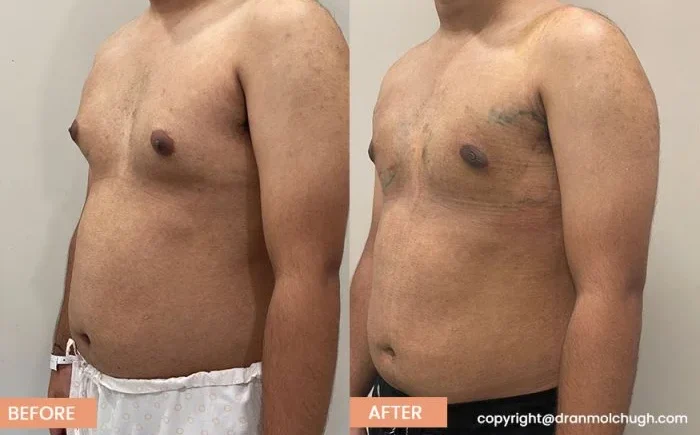
Before-and-After Recovery Example
Consider two patients with similar gynecomastia grades undergoing the same procedure.
Patient A
- Sleeps elevated on the back
- Wears the compression garment consistently
- Follow the recovery instructions carefully
Patient B
- Returns to side sleeping early
- Frequently removes compression
- Ignores elevation recommendations
Although both patients can ultimately heal well, Patient A often experiences:
- Better swelling control
- Greater comfort
- Smoother recovery
This highlights how post-operative habits can influence the healing experience.
Final Thoughts
The best sleeping position after gynecomastia surgery is simple:
Sleep on your back with your upper body elevated.
This position helps:
- Reduce swelling
- Improve comfort
- Protect healing tissues
- Support chest contour development
- Promote a smoother recovery
From Dr. Anmol Chugh’s clinical perspective, patients who follow proper sleeping recommendations often experience a more comfortable healing process and greater confidence during recovery.
Remember, gynecomastia surgery does not end when you leave the operating room. Proper recovery habits, including sleeping position, play an important role in helping you achieve the best possible outcome.
If you’re considering gynecomastia surgery or have questions about recovery, scheduling a consultation with Dr. Anmol Chugh can help you understand what to expect and how to optimize your results safely.
Related Procedures
References
- American Society of Plastic Surgeons. Gynecomastia Surgery.
https://www.plasticsurgery.org/cosmetic-procedures/gynecomastia-surgery - American Society of Plastic Surgeons. Recovery After Gynecomastia Surgery.
https://www.plasticsurgery.org - Braunstein GD. Clinical practice. Gynecomastia. New England Journal of Medicine. 2007;357(12):1229–1237.
https://doi.org/10.1056/NEJMcp070677 - Johnson RE, Murad MH. Gynecomastia: pathophysiology, evaluation, and management. Mayo Clinic Proceedings. 2009;84(11):1010–1015.
https://doi.org/10.1016/S0025-6196(11)60671-X - Fruhstorfer BH, Malata CM. A systematic approach to the surgical treatment of gynecomastia. British Journal of Plastic Surgery. 2003;56(3):237–246.
https://doi.org/10.1016/S0007-1226(03)00037-1 - Rohrich RJ, Ha RY, Kenkel JM, Adams WP Jr. Classification and management of gynecomastia: defining the role of ultrasound-assisted liposuction. Plastic and Reconstructive Surgery. 2003;111(2):909–923.
https://doi.org/10.1097/01.PRS.0000042146.40379.25 - National Health Service (NHS). Gynecomastia (Male Breast Enlargement).
https://www.nhs.uk/conditions/gynaecomastia/
Medically Reviewed By
Dr. Anmol ChughQualifications: MBBS, MS, MCh (Plastic Surgery)
Experience: 16+ Years in Plastic & Aesthetic Surgery
Review Date: 11 Jul 2026
This article has been medically reviewed for accuracy and patient safety.