
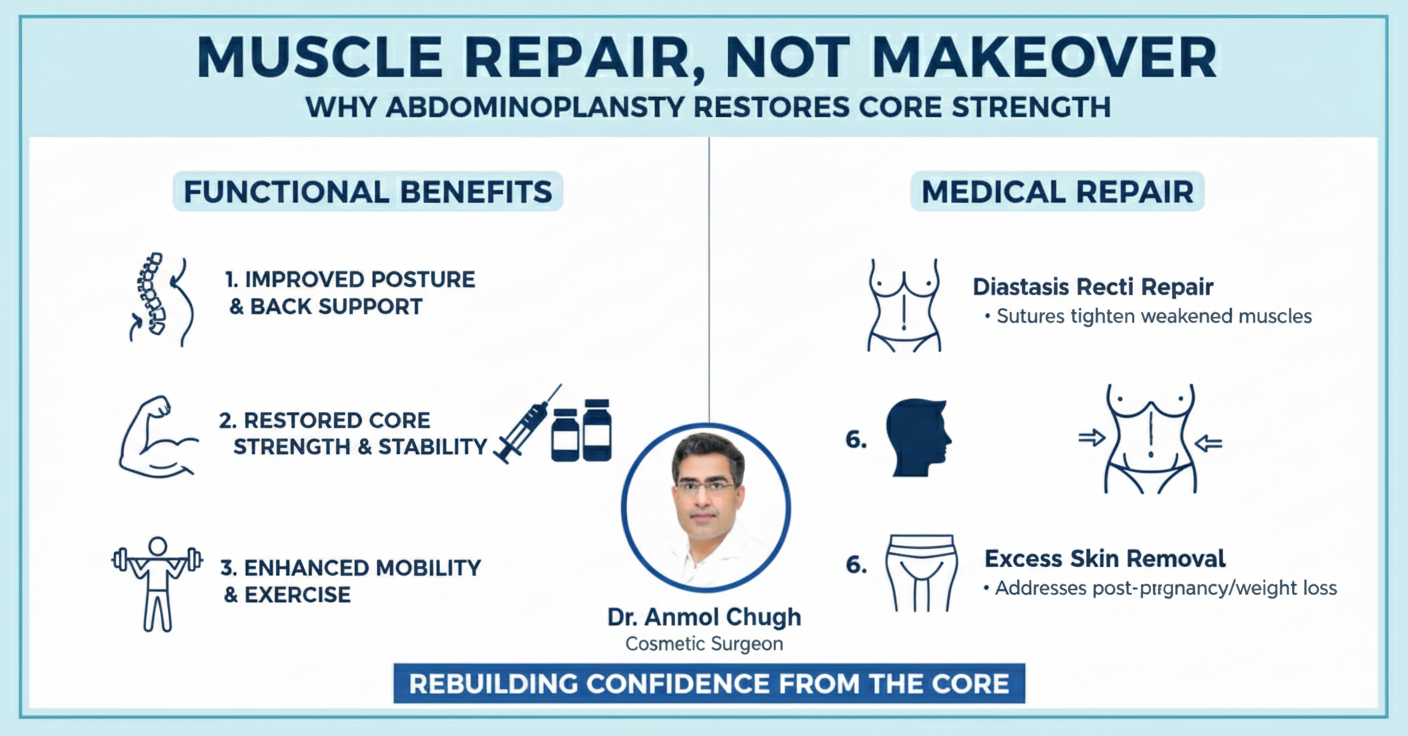
Muscle Repair, Not Makeover: Why Abdominoplasty Restores Core Strength
When most people hear the term “tummy tuck”, they imagine a cosmetic procedure meant to flatten the stomach or reshape the waist.
But here’s the truth, abdominoplasty is far more than a beauty enhancement.
It’s a functional and medical procedure designed to repair weakened abdominal muscles, improve posture, and restore core strength, often after pregnancy, weight loss, or surgery.
As Dr. Anmol Chugh, a leading plastic surgeon at CK Birla Hospital, Gurugram, explains:
“Abdominoplasty is not about chasing a flat belly. It’s about rebuilding the core, the foundation of strength, stability, and confidence.”
Let’s explore how this powerful procedure goes beyond appearance to bring real physical and emotional renewal.
What Really Happens to the Core Muscles
Your core muscles, particularly the rectus abdominis (the “six-pack” muscles), play a vital role in posture, balance, and everyday movement.
During pregnancy, weight fluctuations, or even abdominal surgeries, these muscles can stretch or separate, a condition known as diastasis recti.
When the core weakens, it can lead to:
- A bulging or sagging abdomen
- Lower back pain
- Poor posture
- Digestive discomfort
- Weakened balance and stability
No amount of exercise can fully repair severely separated muscles.
That’s where abdominoplasty steps in, not as a “makeover,” but as muscle reconstruction.
Understanding Abdominoplasty: The Medical Side
Abdominoplasty, commonly known as a tummy tuck, is a surgical procedure that removes excess skin and fat and repairs the underlying abdominal wall.
During the surgery, Dr. Anmol Chugh:
- Brings together separated abdominal muscles
- Tightens the internal abdominal wall
- Removes loose, overstretched skin
- Enhances core strength and posture
The focus is not just on aesthetics, it’s on restoring the integrity and function of the abdominal muscles.
As Dr. Chugh puts it,
“When we repair the muscle layer, we restore strength from the inside out. The cosmetic improvement is simply a healthy side effect of functional restoration.”
Why Muscle Repair Matters More Than You Think
Your core is more than just your abdomen, it’s the center of almost every movement your body makes.
When the abdominal wall weakens or separates, even simple tasks, like standing, lifting, or sitting upright, can strain the lower back and hips.
Muscle repair helps by:
- Reducing chronic lower back pain
- Improving spinal support
- Enhancing posture and balance
- Allowing better breathing mechanics
- Improving exercise performance
In short, muscle repair means mobility, stability, and comfort, it restores the body’s natural foundation.
The Post-Pregnancy Connection: Restoring the “Mom Core”
For many women, pregnancy is the most beautiful transformation, but also one of the most physically demanding.
As the belly grows, the abdominal wall stretches to accommodate the baby. After childbirth, these muscles may not return to their original position, leading to diastasis recti.
Common postpartum issues include:
- Loose, sagging abdominal skin
- Persistent lower belly bulge despite exercise
- Lower back or hip pain
- Core weakness and poor posture
A tummy tuck with muscle repair helps rebuild these separated muscles, tighten the core, and restore both strength and confidence.
As Dr. Anmol Chugh explains,
“For mothers, abdominoplasty is not about vanity, it’s about healing the physical changes pregnancy leaves behind.”
The Science of Diastasis Recti (Muscle Separation)
Diastasis recti occurs when the tissue that connects the two sides of the abdominal muscle stretches beyond its limit.
It’s more than a cosmetic gap, it’s a medical condition that can cause:
- Hernias
- Weak posture
- Core instability
- Digestive issues
Abdominoplasty surgically corrects this by bringing the muscles back together and reinforcing them with sutures, restoring the body’s natural alignment and function.
The Emotional and Functional Benefits
Women (and men) who undergo abdominoplasty often describe the results as life-changing, not because of vanity, but because of relief.
They report:
- Feeling stronger in daily movements
- Better posture and balance
- Freedom from back pain
- The ability to exercise safely again
- Renewed confidence and body comfort
As Dr. Chugh says,
“When your core feels strong, you carry yourself differently, not just physically, but emotionally too.”
It’s not just about flattening the stomach; it’s about rebuilding confidence from within.
Abdominoplasty vs. Liposuction: Understanding the Difference
Many people confuse abdominoplasty with liposuction, but they’re entirely different procedures.
| Feature | Abdominoplasty (Tummy Tuck) | Liposuction |
| Purpose | Repairs muscles and removes excess skin | Removes localized fat deposits |
| Addresses | Diastasis recti, loose skin, weak core | Fat bulges only |
| Result | Stronger core, improved posture, flatter tummy | Slimmer shape, but no muscle repair |
| Ideal For | Post-pregnancy or weight loss recovery | People with good skin tone |
Both can be combined for complete body contouring, but the functional repair of muscles comes only from abdominoplasty.
Health Benefits Beyond the Core
The advantages of abdominoplasty extend well beyond aesthetics:
✅ Improved Posture
Stronger abdominal muscles mean the spine is better supported, reducing slouching and back pain.
✅ Reduced Back and Pelvic Pain
By restoring muscle alignment, the body distributes weight evenly again.
✅ Better Breathing and Core Stability
A tighter abdominal wall supports the diaphragm, improving breathing mechanics.
✅ Stronger Mobility and Exercise Tolerance
Patients can return to fitness with better form and fewer injuries.
✅ Improved Bladder Control
Strengthened muscles can reduce urinary incontinence common after childbirth.
These are medical benefits, not cosmetic perks.
Who Can Benefit from Abdominoplasty
You may be a good candidate if you:
- Have loose or hanging skin after pregnancy or weight loss
- Notice a persistent belly bulge despite diet and exercise
- Experience lower back pain or poor posture
- Have weakened or separated muscles (diastasis recti)
Both women and men who have undergone major physical changes can benefit from this restorative surgery.
The Procedure: What Happens During Surgery
The surgery typically takes 2–4 hours and is done under anesthesia.
Steps:
- An incision is made in the lower abdomen (below the bikini line).
- Excess skin and fat are removed.
- Separated muscles are brought together and stitched firmly.
- The skin is tightened for a smooth, natural contour.
Patients usually return home the same or next day, and light activity can begin within 10–14 days.
Dr. Anmol Chugh ensures that every step is personalized, prioritizing function and safety as much as aesthetics.
Recovery and Core Reconnection
Healing from abdominoplasty is as much about patience as it is about progress.
During recovery:
- Mild soreness or tightness for a few days
- Gradual increase in movement
- Core feels firm as muscles heal
- Support garments aid posture and comfort
By week six, most patients feel stronger, lighter, and more aligned.
Dr. Chugh’s detailed aftercare plan ensures that recovery focuses on regaining strength, not just healing scars.
The Psychological Shift: Feeling Strong Again
The emotional transformation after muscle repair is powerful.
Many patients share how:
- Their confidence returns in both body and movement
- They stand taller, symbolizing inner renewal
- They feel more motivated to stay active and healthy
This confidence isn’t born from vanity, it’s the peace of feeling strong again in your own skin.
As Dr. Anmol Chugh says,
“When function improves, so does self-belief. The body and mind always heal together.”
Debunking Common Myths
| Myth | Truth |
| “Abdominoplasty is just for looks.” | It’s a muscle-repairing, posture-restoring procedure with real health benefits. |
| “You can fix muscle separation with exercise.” | Severe diastasis recti requires surgical repair, workouts alone can’t close the gap. |
| “It’s only for women.” | Both men and women benefit after weight loss or abdominal weakening. |
| “It’s unsafe or leaves big scars.” | Modern techniques used by Dr. Chugh ensure safety, minimal scarring, and lasting results. |
Why Choose Dr. Anmol Chugh for Abdominoplasty
At CK Birla Hospital, Gurugram, Dr. Anmol Chugh is known for blending medical precision with empathy and aesthetic expertise.
His approach focuses on:
- Functional restoration first, aesthetics second
- Personalized planning for every patient
- Advanced techniques for natural, safe outcomes
- Comprehensive pre- and post-surgery care
“We’re not chasing perfection, we’re rebuilding strength, stability, and self-confidence,” says Dr. Chugh.
His patients don’t just see the change, they feel it in every step, stretch, and smile.
Final Thoughts: Strength Is the Real Goal
Abdominoplasty isn’t about transformation; it’s about reconnection.
It repairs what time, pregnancy, or life’s changes have stretched beyond healing, the core muscles that hold us upright and strong.
With Dr. Anmol Chugh’s expertise, this procedure gives back more than a flatter stomach, it restores:
Core strength
Posture
Balance
Confidence
Because real beauty isn’t built from the outside, it’s rebuilt from the core.