Facial Fat Transfer for Men: Is It Growing in Popularity?
Cosmetic surgery is no longer seen as something only women choose. Today, more men are exploring aesthetic treatments to maintain a youthful appearance, improve facial balance, and boost confidence without looking “overdone.”
One procedure that has gained increasing attention is facial fat transfer, also known as facial fat grafting. Unlike dermal fillers, facial fat transfer uses your own body fat to restore lost facial volume and create natural-looking rejuvenation.
One of the most common questions men ask during consultation is:
“Are more men choosing facial fat transfer today?”
The answer is yes. As awareness grows and techniques continue to improve, facial fat transfer is becoming an increasingly popular option for men seeking subtle, long-lasting facial rejuvenation.
In this guide, Dr. Anmol Chugh explains why more men are choosing facial fat transfer, who may benefit from it, and what results can realistically be expected.
Table of Contents
- Quick Answer
- What Is Facial Fat Transfer?
- Why Are More Men Choosing Facial Fat Transfer?
- What Causes Volume Loss in Men?
- Which Areas Can Be Treated?
- Why Do Men Prefer Fat Transfer Over Fillers?
- Is the Result Masculine?
- Can Facial Fat Transfer Be Combined With Other Procedures?
- Dr. Anmol Chugh’s Clinical Perspective
- Common Mistakes Patients Make
- Recovery Protocol Followed at Our Centre
- Safety Checklist
- Who May Not Be a Good Candidate?
- What I Tell My Patients During Consultation
- Frequently Asked Questions
- Final Thoughts
Quick Answer
Yes.
Facial fat transfer is becoming increasingly popular among men because it offers natural-looking facial rejuvenation using the patient’s own fat.
Men commonly choose this procedure to:
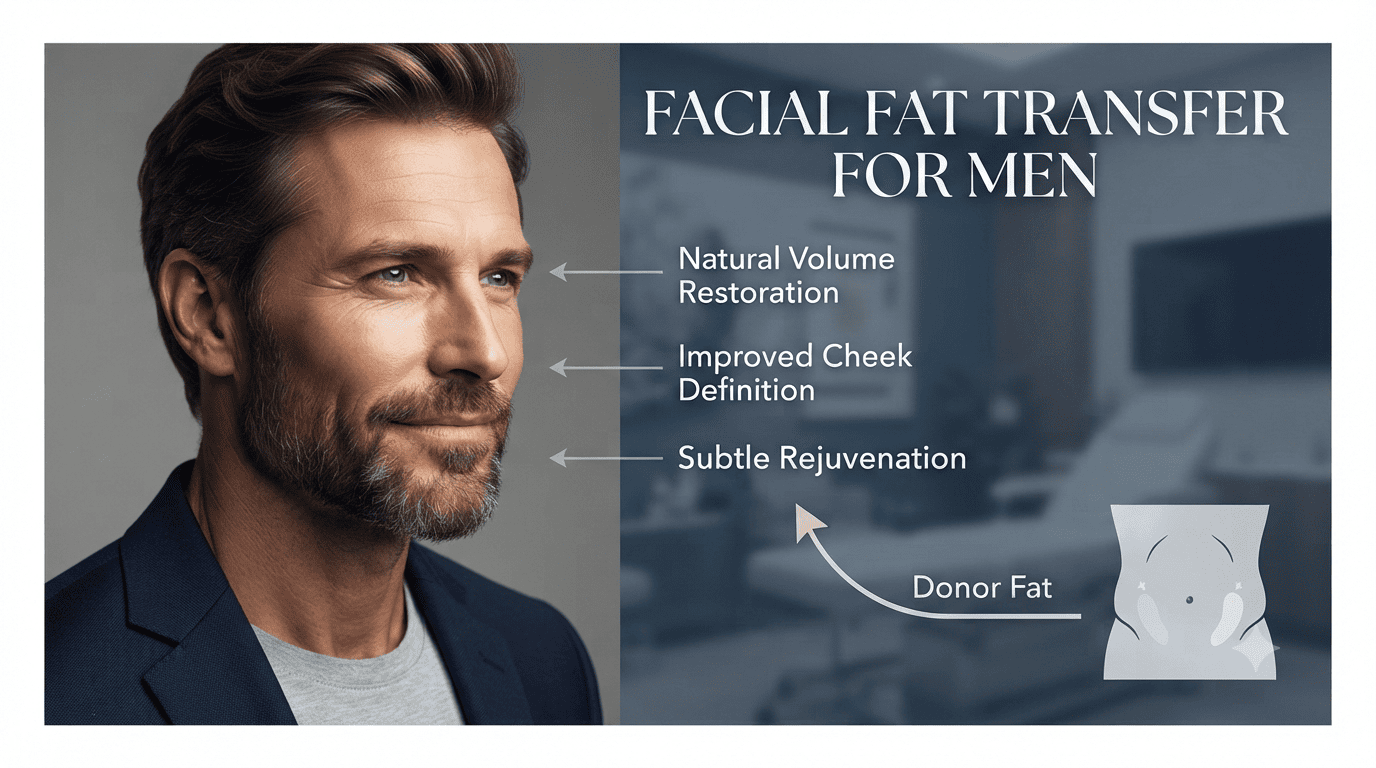
- Restore facial volume
- Improve cheek definition
- Reduce hollow areas
- Soften deep facial folds
- Refresh a tired appearance
Because the procedure uses your own fat instead of synthetic fillers, the results often feel and look very natural.
What Is Facial Fat Transfer?
Facial fat transfer is a procedure in which fat is removed from one area of the body using gentle liposuction.
Common donor areas include:
- Abdomen
- Flanks
- Thighs
The fat is then purified and carefully injected into selected areas of the face.
The procedure restores lost volume while maintaining natural facial movement and expression.
Why Are More Men Choosing Facial Fat Transfer?
Male cosmetic surgery has grown steadily over the past decade.
Many men now seek treatments that improve appearance without making obvious changes.
Facial fat transfer appeals to male patients because it:
- Uses natural tissue
- Produces subtle improvements
- Avoids an artificial appearance
- Offers long-lasting results
- Can be combined with other facial procedures
Most men simply want to look healthier and less tired rather than dramatically younger.
What Causes Volume Loss in Men?
As men age, they gradually lose facial fat and collagen.
Common age-related changes include:
- Hollow cheeks
- Sunken temples
- Deep nasolabial folds
- Under-eye hollowness
- Loss of jawline definition
Weight loss, genetics, smoking, and prolonged sun exposure may accelerate these changes.
Which Areas Can Be Treated?
Facial fat transfer can restore volume in several areas.
Common treatment sites include:
Cheeks
Restores youthful fullness and improves mid-face support.
Temples
Reduces hollowing and creates smoother facial contours.
Under-Eye Area
Improves tear trough hollowing and reduces a tired appearance.
Nasolabial Folds
Softens deep lines extending from the nose to the corners of the mouth.
Jawline and Chin
In selected patients, fat transfer may improve facial balance and contour.
Why Do Men Prefer Fat Transfer Over Fillers?
Both treatments have advantages.
Many men choose fat transfer because:
- It uses their own tissue
- Results are often longer lasting
- There is no synthetic filler material
- The face maintains a natural feel
- Multiple areas can be treated during one procedure
The most appropriate treatment depends on individual goals and facial anatomy.
Is the Result Masculine?
This is one of the biggest concerns for male patients.
The objective is not to create fuller or softer facial features.
Instead, the goal is to restore the volume that has been lost with age while preserving masculine facial proportions.
A carefully planned procedure maintains strong facial contours and avoids an overfilled appearance.
Can Facial Fat Transfer Be Combined With Other Procedures?
Yes.
Depending on the patient’s goals, facial fat transfer may be combined with:
- Blepharoplasty (eyelid surgery)
- Facelift
- Chin augmentation
- Neck liposuction
- Skin tightening procedures
Combination treatments may provide more comprehensive facial rejuvenation while maintaining natural results.
Dr. Anmol Chugh’s Clinical Perspective
More men are seeking facial rejuvenation than ever before, but their expectations are often different from those of female patients.
Most men do not want dramatic changes. They simply want to look healthier, less tired, and more confident.
Facial fat transfer allows us to restore volume gradually while preserving masculine facial structure. When performed conservatively, the results are subtle enough that others usually notice the patient looks refreshed without recognizing that a cosmetic procedure has been performed.
Common Mistakes Patients Make
Thinking Facial Fat Transfer Is Only for Women
Facial ageing affects both men and women.
Many male patients benefit from volume restoration.
Expecting Immediate Final Results
Some swelling is expected initially.
Final results become more apparent as healing progresses over the following months.
Assuming All Transferred Fat Survives
Not every transferred fat cell survives.
An experienced surgeon plans for this by carefully processing and placing the fat.
Comparing Fat Transfer With Fillers
Each treatment has different indications.
A consultation helps determine which option best suits your needs.
Choosing Treatment Based Only on Cost
Facial fat transfer requires careful technique and artistic judgement to achieve natural, balanced results.
Recovery Protocol Followed at Our Centre
Recovery varies according to the amount of fat transferred and donor areas.
Our general protocol includes:
- Gentle compression at donor sites when required
- Cold compresses for facial swelling
- Sleeping with the head elevated
- Temporary activity restrictions
- Wound care guidance
- Follow-up appointments
- Monitoring fat survival during healing
Recovery recommendations are customized for every patient.
Safety Checklist
Before surgery:
✔ Maintain a stable body weight
✔ Stop smoking if advised
✔ Discuss medications
✔ Undergo a complete facial assessment
✔ Understand realistic expectations
✔ Follow all post-operative instructions
✔ Attend scheduled follow-up visits
Who May Not Be a Good Candidate?
Facial fat transfer may not be suitable for patients who:
- Have insufficient donor fat
- Have uncontrolled medical conditions
- Smoke heavily without stopping
- Have active facial infections
- Have unrealistic expectations
A personalized consultation helps determine whether the procedure is appropriate.
What I Tell My Patients During Consultation
I tell my male patients that facial rejuvenation should never make them look like someone else.
The goal is to restore what time has taken away, not to change their identity.
When facial fat transfer is planned carefully, the results simply make a man look healthier, more rested, and naturally refreshed.
Frequently Asked Questions
Is facial fat transfer becoming more popular among men?
Yes. More men are choosing facial fat transfer because it offers natural-looking, long-lasting facial rejuvenation without synthetic fillers.
Will I still look masculine after fat transfer?
Yes. The procedure is planned to preserve masculine facial proportions while restoring lost volume.
How long do the results last?
Many transferred fat cells survive permanently, although natural ageing continues over time.
Is facial fat transfer better than fillers?
Neither treatment is universally better. The right choice depends on your facial anatomy, goals, and the amount of volume loss.
When can I return to work?
Many patients resume light work within one to two weeks, depending on swelling and individual recovery.
Final Thoughts
Facial fat transfer is becoming an increasingly popular option for men who want natural-looking facial rejuvenation without dramatically changing their appearance. By using your own fat to restore lost volume, the procedure can soften signs of ageing while preserving masculine facial features and expressions.
The key to successful results is a personalized treatment plan that respects male facial anatomy and focuses on subtle enhancement rather than overcorrection. During a consultation, Dr. Anmol Chugh carefully evaluates your facial structure, volume loss, and aesthetic goals to recommend the most appropriate approach for long-lasting, natural-looking rejuvenation.
Related Procedures
- Facial Fat Transfer (Fat Grafting)
- Blepharoplasty (Eyelid Surgery)
- Facelift Surgery
- Chin Implant Surgery
- Skin Tightening Treatments
References
- American Society of Plastic Surgeons. Fat Transfer (Fat Grafting).
https://www.plasticsurgery.org/reconstructive-procedures/fat-transfer - The Aesthetic Society. Facial Fat Grafting.
https://www.theaestheticsociety.org - International Society of Aesthetic Plastic Surgery (ISAPS). Global Survey on Aesthetic Procedures.
https://www.isaps.org - Coleman SR, Saboeiro AP. Fat grafting to the face: Evolution of technique and clinical applications. Clinics in Plastic Surgery. 2007;34(2):233–239.
https://doi.org/10.1016/j.cps.2007.01.005 - Pu LLQ. Towards a more rationalized approach to autologous fat grafting. Journal of Plastic, Reconstructive & Aesthetic Surgery. 2012;65(4):413–419.
https://doi.org/10.1016/j.bjps.2011.10.036 - Khouri RK, Khouri RE. Current clinical applications of fat grafting. Plastic and Reconstructive Surgery. 2017;140(3):466e–486e.
https://doi.org/10.1097/PRS.0000000000003620 - American Board of Cosmetic Surgery. Fat Transfer Guide.
https://www.americanboardcosmeticsurgery.org/procedure-learning-center/face/fat-transfer/
Medically Reviewed By
Dr. Anmol ChughQualifications: MBBS, MS, MCh (Plastic Surgery)
Experience: 16+ Years in Plastic & Aesthetic Surgery
Review Date: 21 Jul 2026
This article has been medically reviewed for accuracy and patient safety.