Septoplasty vs Rhinoplasty: What’s the Difference?
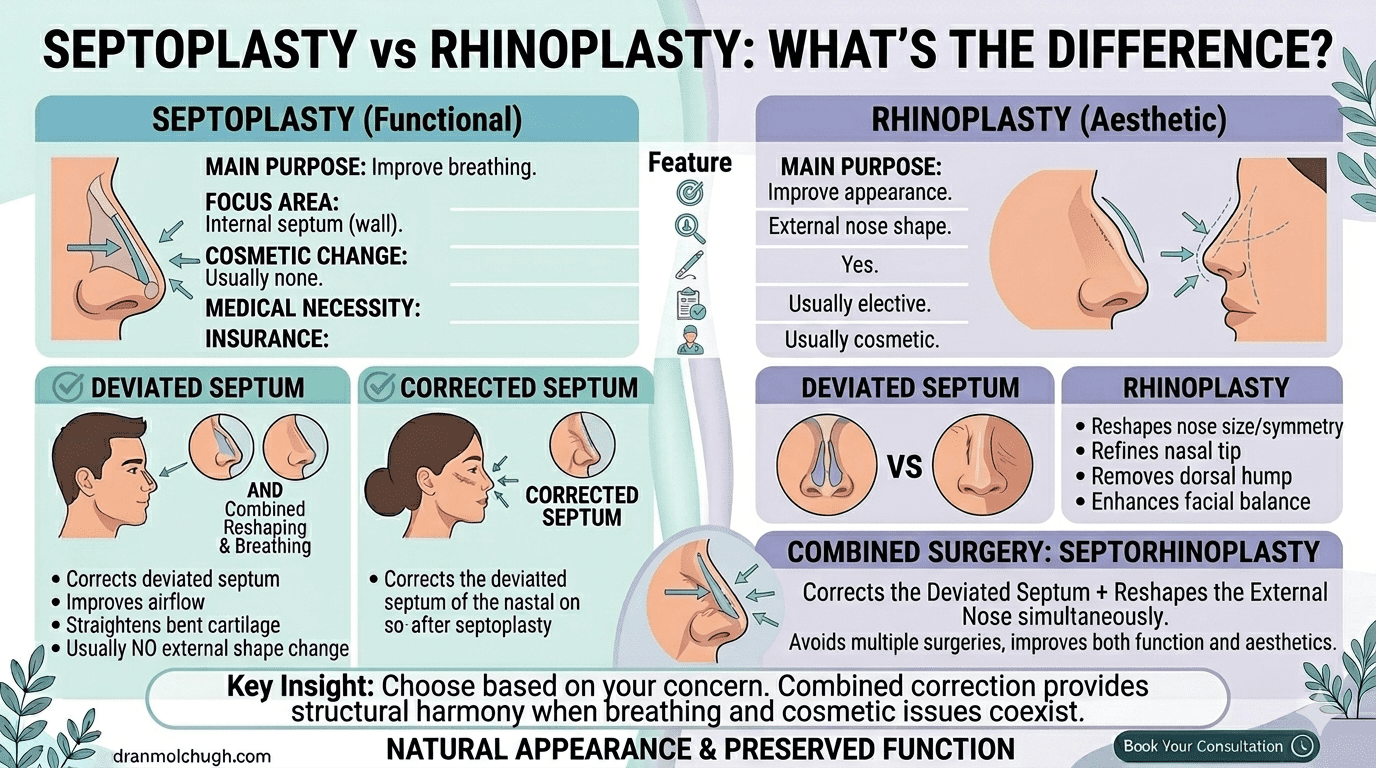
Patients looking for nose surgery often get confused between two procedures, which are commonly performed: Septoplasty and Rhinoplasty. People often think these two treatments are the same procedure due to the fact that both are done on the nose. But their goals and outcomes are quite different, however.
One of the procedures mainly works to help with breathing, and the other works mainly on looks and facial balance. Sometimes, both procedures can even be performed at the same time to achieve greater function and esthetics.
It is helpful to know this distinction prior to making a decision on which treatment to choose. Dr. Anmol Chugh explains in a simple and practical manner about the septoplasty vs rhinoplasty, based on his clinical experience and facial aesthetic principles.
Table of Contents
- Septoplasty vs Rhinoplasty
- Understanding the Basic Difference
- What Is a Deviated Septum?
- What Is Septoplasty?
- What Is Rhinoplasty?
- Can Septoplasty and Rhinoplasty Be Done Together?
- Key Differences Between Septoplasty and Rhinoplasty
- Who Needs Septoplasty?
- Who Needs Rhinoplasty?
- Does Septoplasty Change Nose Shape?
- Recovery Differences
- Which Procedure Is More Painful?
- Risks and Complications
- Common Mistakes Patients Make
- Emotional Impact and Confidence
- Which Procedure Is Right for You?
- Final Thoughts
- Book a Consultation
Septoplasty vs Rhinoplasty (Quick Answer)
Septoplasty is used to fix a deviated nasal septum to enhance breathing; however, rhinoplasty is used to alter the shape of a nose for structural or cosmetic purposes. Function improves with Septoplasty, and appearance improves with Rhinoplasty, sometimes they can be combined.
Understanding the Basic Difference
The main distinction lies in the goal of surgery.
Septoplasty
Septoplasty is a functional surgery that straightens the wall between the two nasal passages (the nasal septum). If this septum is displaced, it may obstruct breathing and may cause breathing difficulties.
Rhinoplasty
Rhinoplasty is a plastic or reconstructive surgery in which the external nose is altered. Can change the shape, bridge, tip, symmetry or overall contour of the nose.
Many individuals undergoing treatment are not aware that some cosmetic problems are accompanied by breathing problems, says Dr. Anmol Chugh. It is always important to consider the internal structure during a consultation, along with the appearance.
Related reading:
👉 Rhinoplasty Cost in India (2026): Nose Surgery Price Breakdown
What Is a Deviated Septum?
A deviated septum happens when the nasal septum moves off-center.
This can lead to:
- Struggling to breathe noses: one or both nostrils
- Nasal blockage
- Snoring
- Frequent sinus infections
- Mouth breathing
- Exercising with insufficient ventilation or poor ventilation while sleeping.
It can be present at birth, or it can be acquired following an injury or trauma.
Dr. Anmol Chugh frequently sees patients in clinical practice who come in for cosmetic nose surgery, but at the same time, they are found to have a significant deviation of the nasal septum that is impeding their breathing.
What Is Septoplasty?
Septoplasty is a surgical procedure that corrects the alignment of the nasal septum.
The procedure involves:
- Straightening bent cartilage or bone
- Removing obstructive portions if necessary
- Improving airflow inside the nose
Importantly:
👉 Septoplasty usually does NOT change the external appearance of the nose.
The primary goal is better breathing and improved nasal function.
What Is Rhinoplasty?
Rhinoplasty focuses on reshaping the visible structure of the nose.
It can help:
- Reduce nose size
- Refine the nasal tip
- Remove a hump on the bridge
- Improve symmetry
- Correct deformities after injury
- Enhance overall facial balance
Rhinoplasty may be cosmetic, reconstructive, or functional, depending on the patient’s concerns.
You can also read:
- Rhinoplasty: When Form Meets Function: What Families Should Know
- Non-Surgical vs Surgical Rhinoplasty: Which Is Right for You?
Can Septoplasty and Rhinoplasty Be Done Together?
Yes — and this is actually very common.
If breathing issues and cosmetic concerns are present, surgeons can conduct:
Septorhinoplasty
This combined procedure:
- Repairs the deviated septum
- Improves breathing
- Alters the appearance of the outside of the nose at the same time
This prevents repeat surgeries and helps to achieve structural harmony.
If both functional and cosmetic corrections are necessary, sometimes the best long-term result is achieved by combining both, Dr. Anmol Chugh says.
Key Differences Between Septoplasty and Rhinoplasty
| Feature | Septoplasty | Rhinoplasty |
| Main Purpose | Improve breathing | Improve appearance |
| Focus Area | Internal septum | External nose shape |
| Cosmetic Change | Usually none | Yes |
| Functional Improvement | Yes | Sometimes |
| Medical Necessity | Often medically required | Usually elective |
| Insurance Coverage | May be covered | Usually cosmetic |
Who Needs Septoplasty?
Septoplasty may be recommended if you experience:
- Chronic nasal blockage
- Difficulty breathing
- Frequent sinus infections
- Sleep-related breathing issues
- A deviated septum was diagnosed on examination
Patients often notice significant improvement in airflow and sleep quality after recovery.
Who Needs Rhinoplasty?
Rhinoplasty is suitable for individuals who:
- Feel unhappy with nose shape or size
- Have asymmetry or a dorsal hump
- Want facial balance improvement
- Have a deformity after injury
- Need structural reshaping
Some patients seek subtle refinement, while others require more comprehensive correction.
Related reading:
👉 Rhinoplasty Side Effects: What to Expect After
Does Septoplasty Change Nose Shape?
Usually, no.
A standard septoplasty focuses internally and does not significantly alter the external appearance of the nose.
However:
- Severe septal deviations can indirectly affect nose shape
- Combined surgery may involve external correction, too
This is why a detailed evaluation is important before surgery planning.
Recovery Differences
Septoplasty Recovery
Recovery is generally quicker because the surgery is internal.
Patients may experience:
- Mild swelling
- Nasal congestion
- Temporary discomfort
Most people resume routine activities within a few days.
Rhinoplasty Recovery
Rhinoplasty recovery is more extensive because external tissues are reshaped.
Common recovery stages include:
- Swelling around the nose and eyes
- Temporary bruising
- Gradual refinement over months
Final rhinoplasty results may take several months to fully settle.
Related reading:
👉 Functional Rhinoplasty: Enhance Your Breathing and Appearance
Which Procedure Is More Painful?
Both procedures are generally well tolerated.
Most patients describe:
- Congestion and pressure are more severe than pain
- Mild discomfort controlled with medication
Rhinoplasty may involve a slightly longer recovery due to structural reshaping.
Risks and Complications
As with all surgeries, each procedure has some risks associated with it.
Possible complications include:
- Bleeding
- Infection
- Swelling
- Temporary breathing discomfort
- Scar tissue formation
Sometimes, the postoperative result may be less than satisfactory or not symmetrical with the nose after rhinoplasty because of poor planning.
These risks are greatly diminished if the surgeon is experienced.
Related reading:
👉 Celebrity Rhinoplasty Surgery: The Procedures Behind the Perfect Nose
Common Mistakes Patients Make
One common mistake is assuming cosmetic nose reshaping will automatically fix breathing problems.
The other is neglecting functionality and just paying attention to looks.
At the end of the consultation, a review should take place of the following:
- Nasal airflow
- Septal alignment
- Facial proportions
- Skin thickness
- Structural support
While discussing clinical consultations, Dr. Anmol Chugh highlights the importance of aesthetics and nasal function in any discussion, instead of just aesthetics.
Emotional Impact and Confidence
Nose breathing and facial balance are significantly related to the nose.
Patients who have the correct procedure done frequently experience:
- Improved confidence
- Improved sleep and breathing.
- Enhanced facial balance
- Feel more comfortable in social environments. Have a more positive social mindset.
If the patient’s expectations are realistic and the surgery is well planned, the satisfaction rate is usually fairly high.
Septoplasty vs Rhinoplasty: Which One Is Right for You?
The answer depends entirely on your concern.
You may need:
- Septoplasty → if your primary issue is breathing
- Rhinoplasty → if your concern is appearance
- Septorhinoplasty → if both issues are present
A detailed medical evaluation is the best way to determine the right approach.
Final Thoughts
Septoplasty and rhinoplasty are two different surgeries performed in the same area of the face, for very different reasons.
Septoplasty can help to alleviate symptoms such as nasal congestion, breathing difficulties, and other issues associated with nasal obstruction. Rhinoplasty can help to reshape the nose and improve its appearance, leading to a more balanced and harmonious facial structure. For many patients, both procedures are necessary for the best and longest-lasting outcome.
Patients will be better equipped to make informed treatment decisions when they understand the difference, rather than making decisions based on cosmetic expectations or information they have gleaned from the internet.
Under the expert eye of Dr. Anmol Chugh and customized treatment plans, patients can expect to see treatment outcomes that are both functional and aesthetically pleasing.
Book a Consultation
If you do not know if you need septoplasty or rhinoplasty, or a combination of both, a consultation of your own can help you understand what treatment you need.
You will be able to:
- Familiarize yourself with the normal anatomy of the nose and its breathing problems.
- Assess aesthetic and functional issues
- Discuss the most appropriate operative treatment, including treatment planning
👉 To take the next step towards breathing better and a balanced facial aesthetic, schedule your appointment with Dr. Anmol Chugh today.
Medically Reviewed By
Dr. Anmol ChughQualifications: MBBS, MS, MCh (Plastic Surgery)
Experience: 16+ Years in Plastic & Aesthetic Surgery
Review Date: 12 May 2026
This article has been medically reviewed for accuracy and patient safety.