Axillary Breast Fat Removal Recovery: What to Expect
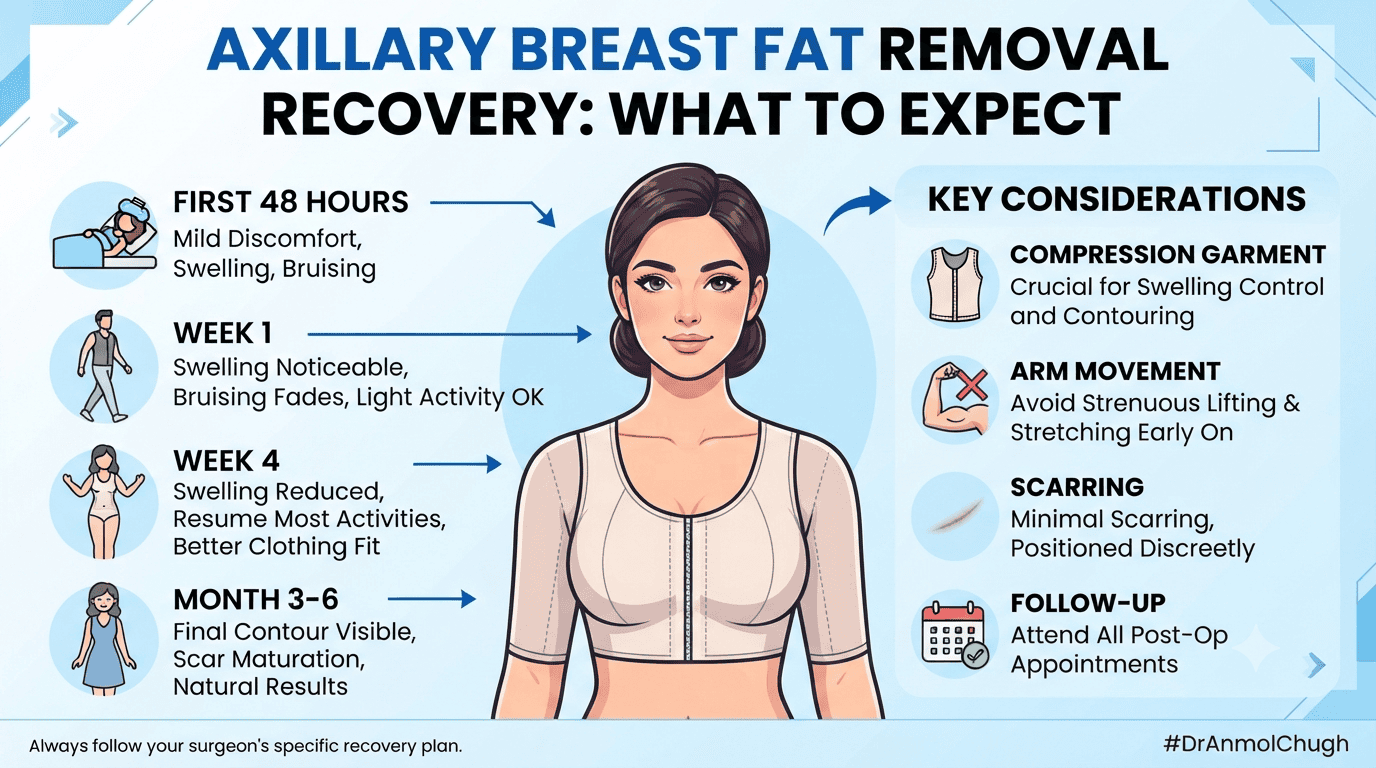
What to Expect During Recovery After Axillary Breast Fat Removal
Many women feel frustrated by the presence of excess fat or fullness in the area between the breast and underarm. This area, commonly referred to as axillary breast fat, can create bulges that remain visible even after weight loss, exercise, or choosing properly fitted clothing.
Patients often tell us:
“No matter what I wear, I still notice fullness near my underarm.”
For some women, this fullness is simply excess fat, while for others, it may involve accessory breast tissue that developed naturally during puberty.
Axillary breast fat removal is a highly effective procedure that can improve contour, enhance clothing fit, and help patients feel more confident. However, understanding the recovery process is just as important as understanding the procedure itself.
In this guide, we’ll explain what to expect after axillary breast fat removal, recovery timelines, common concerns, safety considerations, and practical tips for achieving the best possible outcome.
Table of Contents
- Quick Answer
- What Is Axillary Breast Fat?
- Dr. Anmol Chugh’s Clinical Perspective
- Who Is a Good Candidate?
- What Happens During the Procedure?
- Recovery Timeline
- Recovery Protocol Followed at Our Centre
- Common Mistakes Patients Make
- Common Recovery Symptoms
- Safety Checklist
- Will There Be Scars?
- Who Should Avoid Surgery?
- Frequently Asked Questions
- Final Thoughts
- References
Quick Answer
Most patients can return to routine daily activities within a few days after axillary breast fat removal.
However:
- Swelling and bruising are common during the first few weeks.
- Most visible recovery occurs within 4–6 weeks.
- Scar maturation continues for several months.
- Final contour improvements are usually appreciated after 3–6 months.
Recovery is generally straightforward when patients follow post-operative instructions carefully.
What Is Axillary Breast Fat?
Axillary breast fat refers to excess fullness located in the underarm region, near the outer portion of the breast.
This fullness may be caused by:
- Localized fat deposits
- Accessory breast tissue
- Hormonal changes
- Weight gain
- Genetics
Some patients notice the issue only while wearing fitted clothing, while others experience discomfort, irritation, or self-consciousness on a daily basis.
Dr. Anmol Chugh’s Clinical Perspective
One important point many patients do not realize is that not every underarm bulge is caused by fat alone.
During consultation, a careful examination helps determine whether the fullness is due to:
- Excess fat
- Glandular accessory breast tissue
- Loose skin
- A combination of these factors
Accurate diagnosis is essential because treatment planning depends on the underlying cause.
Who Is a Good Candidate for Axillary Breast Fat Removal?
You may be a suitable candidate if:
- You have persistent underarm fullness.
- Exercise has not improved the area.
- Clothing or bras create visible bulges.
- You maintain a relatively stable weight.
- You have realistic expectations.
The procedure is often combined with:
- Liposuction
- Breast contouring procedures
- Breast reduction
- Breast lift surgery
depending on the patient’s goals.
What Happens During the Procedure?
Liposuction
When fullness is primarily caused by fat, liposuction can effectively remove excess tissue and improve contour.
Surgical Excision
If accessory breast tissue is present, direct removal may be necessary.
Combination Approach
Many patients benefit from a combination of liposuction and tissue excision to achieve optimal contour and smoothness.
The exact approach depends on individual anatomy and surgical goals.
Recovery Timeline: Week-by-Week
First 24–72 Hours
Immediately after surgery, patients can expect:
- Mild discomfort
- Swelling
- Bruising
- Tightness in the treated area
Most patients describe the sensation as soreness rather than severe pain.
What I Tell My Patients During Consultation
The first few days are usually easier than most patients anticipate.
The biggest challenge is often adjusting arm movements while the area begins to heal.
Gentle movement is encouraged, but excessive stretching should be avoided.
Week 1
During the first week:
- Swelling is most noticeable.
- Bruising becomes more visible.
- Mild tenderness is common.
- Arm movements may feel restricted.
Patients are typically able to:
- Walk normally.
- Perform light activities.
- Return to desk-based work in many cases.
depending on the extent of the procedure.
Recovery Protocol Followed at Our Centre
Patients are provided with detailed guidance regarding:
- Compression garment usage
- Wound care
- Activity restrictions
- Sleeping positions
- Follow-up appointments
Early monitoring helps ensure smooth recovery and prompt management of any concerns.
Week 2
By the second week:
- Bruising usually starts fading.
- Swelling gradually improves.
- Discomfort decreases significantly.
- Daily activities become easier.
Many patients begin noticing early contour improvements, although final results are still hidden by residual swelling.
Common Mistakes Patients Make
A common mistake is assuming recovery is complete because discomfort has improved.
Internal healing continues even when patients feel better externally.
Returning to strenuous activity too early may increase swelling and delay recovery.
Weeks 3–4
At approximately one month:
- Most bruising has resolved.
- Swelling is noticeably reduced.
- Incisions continue healing.
- The treated area begins looking smoother.
Patients often report:
- Better clothing fit.
- Improved bra comfort.
- Increased confidence in wearing sleeveless outfits.
This is usually when contour improvements become more apparent.
Months 2–3
During this stage:
- Residual swelling continues decreasing.
- Skin gradually adapts to the new contour.
- Surgical scars become softer.
- Results appear increasingly natural.
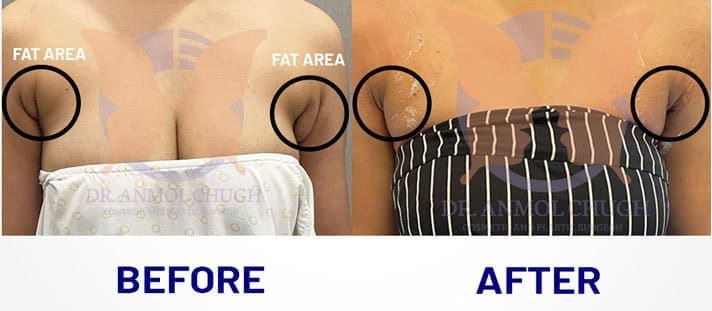
Before-and-After Example
A patient who previously noticed visible bulging under fitted tops may observe:
- Smoother underarm contours
- Better transition between the breast and the arm
- Reduced fullness when wearing bras
- Improved overall silhouette
The change is often subtle but highly meaningful to the patient.
Months 3–6
Most patients reach near-final results between three and six months.
By this point:
- Swelling is largely resolved.
- Scar maturation progresses.
- Contours become stable.
- Final outcomes are easier to evaluate.
Common Recovery Symptoms
Swelling
Swelling is completely normal and may persist for several weeks.
Bruising
Most bruising resolves within two to three weeks.
Tightness
Temporary tightness often improves as healing progresses.
Numbness
Some patients experience temporary numbness around the treated area.
This generally improves over time as nerves recover.
Safety Checklist for Recovery
To support optimal healing:
✓ Wear recommended compression garments
✓ Attend follow-up appointments
✓ Avoid smoking
✓ Stay hydrated
✓ Follow wound care instructions
✓ Avoid heavy lifting until cleared
✓ Maintain stable body weight
These simple measures can significantly improve recovery quality.
Common Mistakes Patients Make
Ignoring Compression Garments
Compression helps control swelling and supports contour development.
Lifting Heavy Objects Too Soon
Excessive arm movement may stress healing tissues.
Skipping Follow-Up Visits
Regular assessment helps identify concerns early.
Judging Results Too Early
Swelling can temporarily hide the final contour.
Patience is important during recovery.
Will There Be Scars?
Scarring depends on the surgical technique used.
Liposuction Alone
Typically leaves very small scars that are often difficult to notice once healed.
Surgical Excision
May result in a small scar hidden within natural underarm creases whenever possible.
What I Tell My Patients
Most patients focus heavily on scars before surgery.
After recovery, they are usually far more focused on the improvement in contour than on the scar itself.
Proper scar care can further improve scar appearance over time.
Who Should Not Undergo Axillary Breast Fat Removal?
The procedure may not be suitable for:
- Patients with unrealistic expectations
- Individuals with uncontrolled medical conditions
- Active smokers unwilling to stop smoking
- Patients with significant weight fluctuations
- Those not prepared for the recovery requirements
A detailed consultation is necessary to determine suitability.
Frequently Asked Questions
Is axillary breast fat removal painful?
Most patients describe discomfort as mild to moderate and manageable with prescribed medications. The soreness usually improves steadily during the first week.
When can I return to work?
Many patients return to desk-based work within a few days, depending on the extent of treatment and the nature of their job.
Can the fat come back?
Removed fat cells do not regenerate. However, significant weight gain can enlarge the remaining fat cells, which may affect the overall contour.
Will I need compression garments?
Yes. Compression garments are commonly recommended to help reduce swelling, support healing tissues, and improve contour during recovery.
When will I see the final results?
Although early improvements become noticeable within a few weeks, final results are usually appreciated after 3–6 months, once swelling has completely settled and tissues have fully healed.
Final Thoughts
Axillary breast fat removal can significantly improve body contour, clothing fit, and self-confidence for women bothered by persistent underarm fullness.
Recovery is generally straightforward, with most patients returning to normal daily activities relatively quickly. Understanding each stage of the healing process helps set realistic expectations and allows patients to focus on a smooth recovery.
Whether the fullness is caused by localized fat, accessory breast tissue, or a combination of both, careful evaluation and individualized treatment planning are essential for achieving natural-looking results.
With expert surgical care, realistic expectations, and proper post-operative management, patients can enjoy smoother contours and long-lasting improvement.
If you are considering axillary breast fat removal, a personalized consultation with Dr. Anmol Chugh can help determine the most suitable treatment approach based on your anatomy, goals, and overall health.
References
- American Society of Plastic Surgeons. Liposuction Procedure Guide.
https://www.plasticsurgery.org/cosmetic-procedures/liposuction - Rohrich RJ, Beran SJ, Fodor PB. The role of liposuction in body contouring. Plastic and Reconstructive Surgery. 2001;107(5):1363–1369.
https://doi.org/10.1097/00006534-200104150-00040 - Bland KI, Copeland EM, Klimberg VS, Gradishar WJ. The Breast: Comprehensive Management of Benign and Malignant Diseases. 5th Edition. Elsevier; 2017.
- American Society of Breast Surgeons. Accessory Breast Tissue Overview.
https://www.breastsurgeons.org - Loukas M, Clarke P, Tubbs RS. Accessory breasts: A historical and current perspective. American Surgeon. 2007;73(5):525–528.
- Matarasso A. Superficial suction lipectomy: The evolution and current applications of liposuction. Aesthetic Surgery Journal. 2001;21(6):529–541.
https://doi.org/10.1067/maj.2001.121861 - International Society of Aesthetic Plastic Surgery. Patient Safety Resources.
https://www.isaps.org - American Board of Cosmetic Surgery. Liposuction Recovery Guide.
https://www.americanboardcosmeticsurgery.org/procedure-learning-center/body/liposuction-guide/
Related Procedures
- Breast Fat Transfer
- Breast Implant Surgery
- Breast Lift Surgery
- Breast Reduction Surgery
- Mommy Makeover Surgery
- Tummy Tuck Surgery
Medically Reviewed By
Dr. Anmol ChughQualifications: MBBS, MS, MCh (Plastic Surgery)
Experience: 16+ Years in Plastic & Aesthetic Surgery
Review Date: 02 Jul 2026
This article has been medically reviewed for accuracy and patient safety.