How to Get Scar-Free Results from Breast Augmentation
Worried About Scars After Breast Augmentation?
One of the biggest concerns women have before breast augmentation surgery is whether the scars will be visible.
The truth is that every surgical incision leaves a scar, but modern surgical techniques and proper aftercare can make those scars extremely small and difficult to notice over time.
An experienced plastic surgeon carefully plans the incision, uses meticulous closure techniques, and guides you through recovery to help scars heal as discreetly as possible.
In this guide, you’ll learn what affects scar healing, how to reduce the appearance of scars, and what you can realistically expect after breast augmentation.
Table of Contents
- Quick Answer
- Why Do Breast Augmentation Scars Form?
- Where Are Breast Augmentation Incisions Placed?
- What Affects Scar Healing?
- Tips to Minimise Breast Augmentation Scars
- What I Tell My Patients During Consultation
- Recovery Timeline for Scar Healing
- When Should You Contact Your Surgeon?
- Frequently Asked Questions
- Final Thoughts
- References
Quick Answer
Breast augmentation cannot be completely scar-free because every incision heals with a scar.
However, when surgery is performed using advanced techniques and patients follow proper scar care, the scars usually become thin, soft, and well hidden within 6–18 months.
The final appearance depends on:
- Surgical technique
- Incision location
- Skin type
- Genetics
- Aftercare
- Lifestyle habits such as smoking
Why Do Breast Augmentation Scars Form?
Scars are a natural part of the body’s healing process.
When the skin is cut, the body produces collagen to repair the wound. During the first few months, the scar may appear pink, firm, or slightly raised.
As healing continues, the scar gradually becomes:
- Flatter
- Softer
- Lighter in colour
- Less noticeable
For most patients, scars continue improving for up to 12–18 months after surgery.
Where Are Breast Augmentation Incisions Placed?
The location of the incision plays a major role in how visible the scar will be.
Inframammary Fold (Under the Breast)
This is the most commonly used incision.
It is placed within the natural fold beneath the breast, allowing the scar to remain hidden in everyday activities.
It also provides excellent surgical access and precise implant placement.
Periareolar Incision
This incision follows the border between the darker areola and surrounding skin.
Because of the natural colour difference, the scar often blends well after healing.
It may not be suitable for every patient, depending on nipple size and surgical goals.
Transaxillary Incision
This approach places the incision inside the armpit instead of on the breast.
While it avoids a breast scar, it is appropriate only for selected patients and implant types.
Your surgeon will recommend the safest option based on your anatomy and desired outcome.

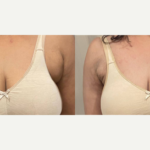
Breast Augmentation with Implants – Case Study for 40 year old female
What Affects Scar Healing?
Every patient heals differently.
Several factors influence how noticeable a scar becomes.
Surgical Technique
Gentle tissue handling, precise incision planning, and tension-free wound closure help reduce visible scarring.
Skin Type and Genetics
Some individuals naturally develop thicker scars or are more prone to keloids or hypertrophic scars.
Smoking
Smoking reduces blood flow and oxygen delivery to healing tissues, increasing the risk of delayed healing and wider scars.
Stopping smoking before and after surgery significantly improves healing.
Sun Exposure
Fresh scars become darker when exposed to ultraviolet light.
Protecting scars from direct sunlight during the first year helps them fade more evenly.
Infection or Poor Wound Care
Keeping the incision clean and following your surgeon’s instructions reduces complications that may worsen scarring.
Also Read: Breast Implants: What Patients Should Know Before Surgery
Tips to Minimise Breast Augmentation Scars
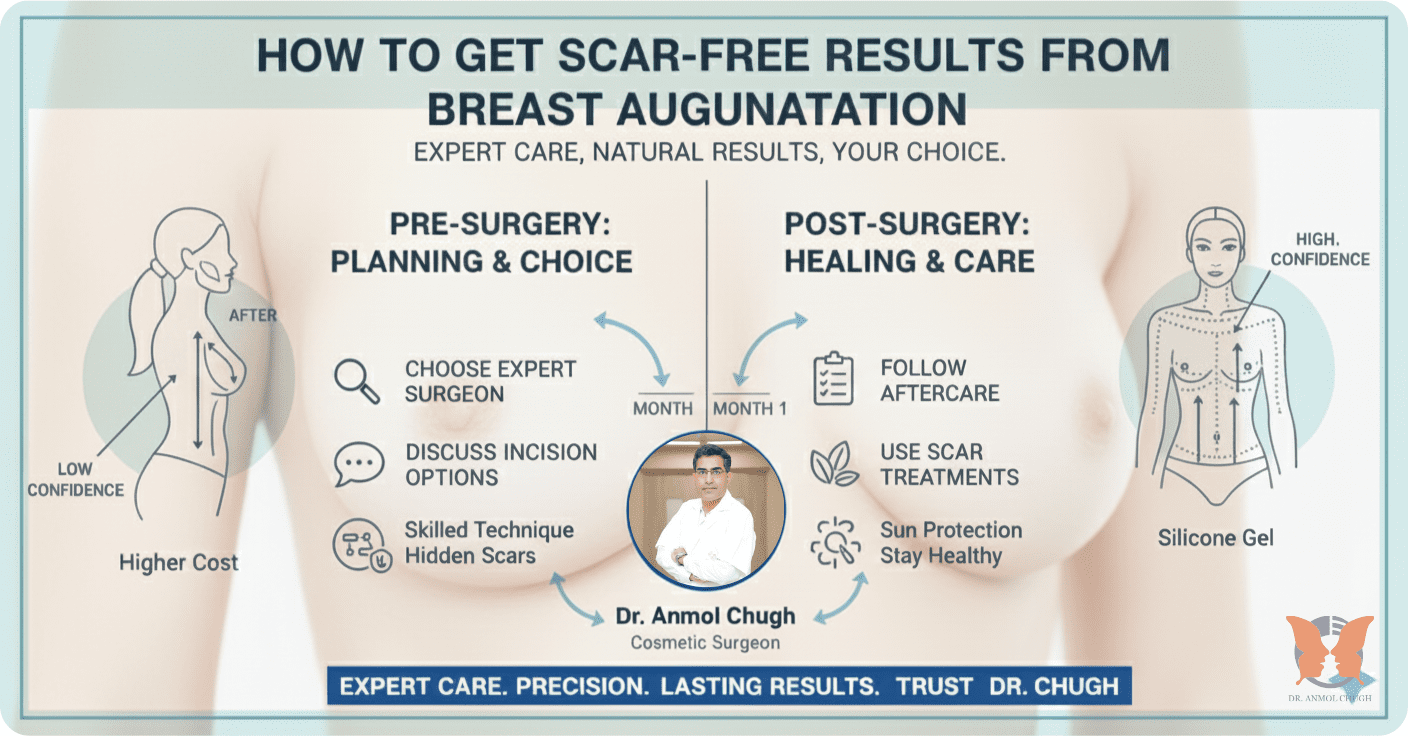
Choose an Experienced Plastic Surgeon
Scar quality begins in the operating room.
An experienced plastic surgeon carefully selects the incision location and closes the wound in multiple layers to minimise tension on the skin.
Follow Your Recovery Instructions
Good recovery habits help wounds heal properly.
This includes:
- Wearing the recommended surgical bra
- Keeping the incision clean
- Taking prescribed medications
- Avoiding strenuous activities until cleared
Use Silicone-Based Scar Therapy
Once the incision has fully healed, your surgeon may recommend:
- Silicone gel
- Silicone sheets
Clinical studies show that silicone products can improve scar softness, thickness, and colour during healing.
Avoid Smoking and Nicotine
Even nicotine from vaping or chewing tobacco can reduce blood supply to healing tissues.
Patients who avoid nicotine generally experience better scar quality.
Eat a Healthy Diet
Healing requires adequate nutrition.
Protein, vitamin C, zinc, and proper hydration support collagen production and wound repair.
Protect Your Scars From the Sun
Fresh scars should be protected with clothing or sunscreen after healing.
Ultraviolet exposure can make scars darker and more noticeable.
What I Tell My Patients During Consultation
One of the most common questions I hear is:
“Doctor, will people be able to see my scars?”
My answer is always honest.
Every surgery leaves a scar.
The goal is not to eliminate scars completely, but to place them where they are naturally hidden and help them mature into fine lines that are difficult to notice.
I also explain that surgery is only one part of the journey.
Following the recovery plan, avoiding smoking, wearing the recommended support bra, and attending follow-up visits all contribute to better scar healing.
Patients who actively participate in their recovery usually achieve the best long-term results.
Also Read: 7 Tips to Maintain Your Breast Augmentation Results
Recovery Timeline for Scar Healing
First Two Weeks
- Mild swelling
- Bruising
- Incisions begin closing
One to Three Months
- Scars may appear pink or slightly firm.
- Swelling continues to improve.
Three to Six Months
- Scars gradually soften.
- Colour begins fading.
- Breast shape becomes more natural.
Six to Eighteen Months
- Final scar maturation occurs.
- Most scars become significantly lighter and flatter.
Healing speed varies from one patient to another.
When Should You Contact Your Surgeon?
Most scars heal normally.
However, contact your surgeon if you notice:
- Increasing redness
- Persistent drainage
- Fever
- Severe pain
- Wound separation
- Rapidly thickening or painful scars
Early treatment can prevent more significant problems.
Frequently Asked Questions
Will breast augmentation scars disappear completely?
No. Every incision leaves a scar, but most become very difficult to notice after complete healing.
Can scar creams remove scars?
No cream can completely erase a scar. Silicone-based treatments have the strongest evidence for improving scar appearance.
When can I start scar treatment?
Only after the incision has completely healed and your surgeon recommends beginning silicone therapy.
Does implant size affect scarring?
The scar depends more on surgical planning, tissue handling, and healing than on implant size alone.
Can old breast augmentation scars be improved?
Yes. Scar revision surgery, laser treatments, or other therapies may improve mature scars in selected patients.
Final Thoughts
Breast augmentation can improve breast volume, shape, and confidence, but it is important to have realistic expectations about scars.
While no surgery is completely scar-free, modern surgical techniques and proper aftercare allow most scars to heal into thin, well-hidden lines.
Choosing an experienced plastic surgeon, following recovery instructions carefully, and maintaining a healthy lifestyle all contribute to the best possible outcome.
If you are considering breast augmentation, a personalised consultation with Dr. Anmol Chugh can help you understand your incision options, expected scar healing, and the approach that best matches your goals.
References
- American Society of Plastic Surgeons. Breast Augmentation.
https://www.plasticsurgery.org/cosmetic-procedures/breast-augmentation - American Board of Cosmetic Surgery. Breast Augmentation Guide.
https://www.americanboardcosmeticsurgery.org/procedure-learning-center/breast/breast-augmentation-guide/ - Spear SL, Bulan EJ, Venturi ML. Breast augmentation. Plastic and Reconstructive Surgery. 2004;114(5):73E–81E.
https://doi.org/10.1097/01.PRS.0000135854.53817.27 - Adams WP Jr. The process of breast augmentation: Four sequential steps for optimizing outcomes. Plastic and Reconstructive Surgery. 2008;122(6):1892–1900.
https://doi.org/10.1097/PRS.0b013e31818cc3bc - Mustoe TA, Cooter RD, Gold MH, et al. International clinical recommendations on scar management. Plastic and Reconstructive Surgery. 2002;110(2):560–571.
https://doi.org/10.1097/00006534-200208000-00031 - National Institute for Health and Care Excellence (NICE). Cosmetic procedures – Evidence and guidance.
https://www.nice.org.uk - American Society for Aesthetic Plastic Surgery (The Aesthetic Society). Breast Augmentation Patient Guide.
https://www.theaestheticsociety.org/patient-resources
Medically Reviewed By
Dr. Anmol ChughQualifications: MBBS, MS, MCh (Plastic Surgery)
Experience: 16+ Years in Plastic & Aesthetic Surgery
Review Date: 13 Dec 2025
This article has been medically reviewed for accuracy and patient safety.